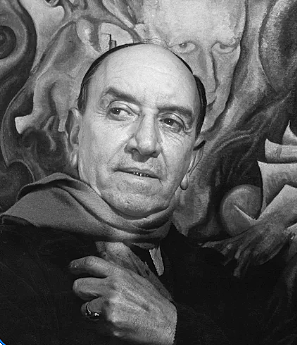
 Roberto Montenegro Nervo (February 19, 1885 – October 13, 1968) was a prominent Mexican painter, muralist, illustrator, and set designer whose life and
career bridged traditional Mexican folklore with European modernism.
Roberto Montenegro Nervo (February 19, 1885 – October 13, 1968) was a prominent Mexican painter, muralist, illustrator, and set designer whose life and
career bridged traditional Mexican folklore with European modernism.Queer Places:
Panteón Civil de Dolores, Av Constituyentes S/N, Panteón Civíl de Dolores, Miguel Hidalgo, 11100 Ciudad de México, CDMX, Mexico
Roberto Montenegro Nervo (February 19, 1885 – October 13, 1968) was a prominent Mexican painter, muralist, illustrator, and set designer whose life and
career bridged traditional Mexican folklore with European modernism.
Born in Guadalajara, Jalisco, to Colonel Ignacio L. Montenegro and María Nervo—an aunt of the renowned poet Amado Nervo—he grew up as part of the elite class benefiting from the Porfirio Díaz regime before his family relocated to the United States around the outbreak of the Mexican Revolution in 1910.
Montenegro’s early artistic education began under the influence of Félix Bernardelli in Guadalajara, who introduced him to Art Nouveau. He arrived in Mexico City in 1903 to study architecture, but soon transitioned entirely to the arts, attending the Academy of San Carlos between 1904 and 1906 alongside future luminaries like Diego Rivera, Saturnino Herrán, and Francisco Goitia. In 1906, after a coin toss decided who would travel to Europe, Montenegro departed for Madrid, studying at the Academy of San Fernando under Ricardo Baroja and immersing himself in the masterworks of the Prado. From 1907 to 1910, he lived in Paris, where he encountered the early currents of Cubism and connected with avant-garde figures such as Pablo Picasso, Georges Braque, and Juan Gris, though his own artistic trajectory remained uniquely focused on symbolism, fantasy, and folk elements rather than strict Cubist abstraction. When World War I broke out, he took refuge in Barcelona and Mallorca, living among local fishing communities and collaborating with Spanish artists before returning permanently to Mexico in 1921.
As an artist, Montenegro wore many hats. He was an early and vital participant in the Mexican muralism movement, recruited by Secretary of Education José Vasconcelos. His most significant mural work was executed in the former San Pedro y San Pablo monastery, featuring landmark compositions such as Árbol de la Vida (Tree of Life) and Fiesta de la Santa Cruz. However, because his style lacked the aggressive socio-political drama of contemporaries like Diego Rivera, José Clemente Orozco, and David Alfaro Siqueiros, he gradually stepped away from large-scale murals to focus on book illustration, publishing, portraiture, and stage design. His prolific illustration career included collaborations with the literary magazine Revista Moderna, as well as projects with prominent writers like Rubén Darío, Ramón del Valle-Inclán, and the members of the Los Contemporáneos group such as Salvador Novo and Carlos Pellicer. Later in life, he achieved wide acclaim for his portraiture—capturing figures such as Frida Kahlo, Dolores del Río, and Rufino Tamayo—as well as his pioneering efforts in the preservation, curation, and promotion of Mexican folk art and handcrafts, serving as the first director of the folk art museum at the Palacio de Bellas Artes.
Within the social and cultural landscape of mid-century Mexico, Montenegro occupied a significant space in the country's interconnected intellectual and LGBTQ networks. Living openly as a gay man during a deeply conservative era, he was part of an elite, cosmopolitan circle of artists, writers, and diplomats who navigated social constraints through private salons, domestic hospitality, and patronage networks. He frequented the legendary salon hosted by Antonio Adalid Pradel and Antonio Dodero, which served as a vital intergenerational refuge for gay intellectuals, government ministers, and artists. His social sphere included close associations with major figures of the era such as Salvador Novo, Xavier Villaurrutia, and Elías Nandino. Although he maintained a wide circle of friends in his youth, Montenegro's later years were marked by increasing isolation in his Mexico City studio apartment, accompanied only by his poodles, while he continued to produce deeply personal canvas works, including late-career homoerotic male nudes. Recognized nationally for his contributions to culture, he received the prestigious Premio Nacional de las Artes in 1967. Montenegro passed away on October 13, 1968, and was interred in the Panteón Civil de Dolores in Mexico City.
References:
Other references:
Support this project
This website is a passion project researched, developed, and funded entirely by me. If you find the content valuable and would like to help support the ongoing research and hosting costs, any contribution is deeply appreciated.
Thank you for keeping this independent resource alive!
My books on Amazon: Elisa Rolle's books