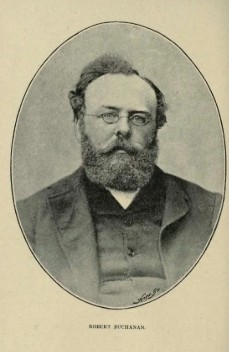
 Robert Williams Buchanan (August 18, 1841 – June 10, 1901) was a prolific Scottish poet, novelist, and playwright.
Queer Places:
St. John the Baptist Churchyard, Church Rd, Southend-on-Sea SS1 2AL, United Kingdom
Robert Williams Buchanan (August 18, 1841 – June 10, 1901) was a prolific Scottish poet, novelist, and playwright.
Born in Caverswall, Staffordshire, he was the son of Robert Buchanan, an itinerant lecturer and journalist who supported Robert Owen's socialist schemes. Growing up in a household with strong ties to radicalism, Buchanan was exposed to prominent socialist figures from an early age and was raised without religious training.
After spending his early years in Glasgow, where he attended the high school and university, Buchanan moved to London in 1860 to pursue a writing career. His initial years in the capital were marked by financial hardship following his father's bankruptcy.
His literary reputation was established with collections such as Undertones (1863), Idyls and Legends of Inverburn (1865), and London Poems (1866). However, he became infamous for his 1871 article "The Fleshly School of Poetry," published under the pseudonym Thomas Maitland, in which he harshly criticized the work of Dante Gabriel Rossetti and Algernon Charles Swinburne. This critique sparked a long-standing controversy that significantly alienated him from many of his contemporaries and impacted his career.
Throughout his life, he was a versatile writer, producing numerous novels, including The Shadow of the Sword (1876) and God and the Man (1881), as well as several successful plays. He married Mary Jay in 1861 and later adopted her sister, Harriett Jay, who would become his collaborator and, ultimately, his biographer. Buchanan struggled financially throughout much of his later life and died in poverty in 1901.
Buchanan had a lifelong, close friendship with the poet and essayist Roden Noel. They met in the summer of 1865. In her biography of Buchanan, Harriett Jay described the bond as "a deeper friendship" and noted that Buchanan felt "feelings of deep affection" for Noel throughout his life. Following Noel's death, Buchanan wrote of him in his diary, referring to him as "the beloved friend who was taken from me yesterday" and praising him as a "noble-hearted man."
References:
 Homosexuals in History, A Study of Ambivalence in Society, Literature and the Arts, 1977 by A.L. Rowse |
Other references:
Support this project
This website is a passion project researched, developed, and funded entirely by me. If you find the content valuable and would like to help support the ongoing research and hosting costs, any contribution is deeply appreciated.
Thank you for keeping this independent resource alive!
My books on Amazon: Elisa Rolle's books