Queer Places:
University of Nebraska, 1400 R St, Lincoln, NE 68588, United States
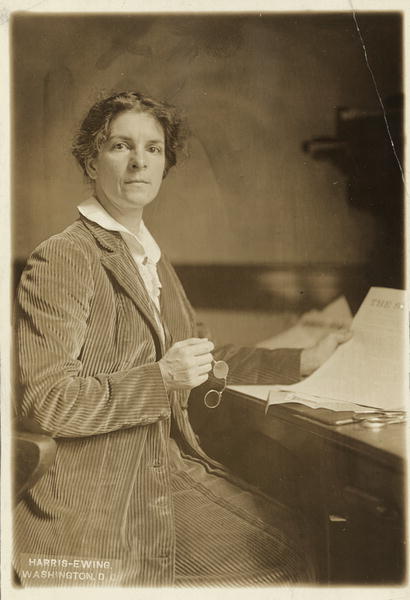 Rheta Louise Childe Dorr (November 2, 1866 – August 8, 1948) was a pioneering American journalist, suffragist, newspaper editor, writer, and political
activist who is best remembered as one of the leading female muckraking journalists of the Progressive Era and as the founding editor of the influential
newspaper The Suffragist.
Rheta Louise Childe Dorr (November 2, 1866 – August 8, 1948) was a pioneering American journalist, suffragist, newspaper editor, writer, and political
activist who is best remembered as one of the leading female muckraking journalists of the Progressive Era and as the founding editor of the influential
newspaper The Suffragist.
Born as Rheta Louise Child to Lucie Mitchell and Edward Payson Child, a New York-born druggist, she experienced a defining moment at age twelve when
she snuck out of her family home to hear Susan B. Anthony and
Elizabeth Cady Stanton speak on women's suffrage, instantly committing herself to the cause of voting
rights. After studying for two years at the University of Nebraska, she moved to New York City in 1890 to pursue journalism. In 1892, she married John
Pixley Dorr, a conservative businessman, and moved with him to Seattle, where she worked as a freelance journalist interviewing returning Alaskan gold
miners. Facing friction from her traditionalist husband, the couple separated in 1898, prompting Rheta to return East with her young son, Julian Childe
Dorr, to build an independent career as a single mother.
In 1902, Dorr joined the New York Evening Post, where she conducted undercover investigations inside factories, mills, and department stores to expose
the grim labor conditions faced by women and children. Despite her professional success, she encountered severe gender discrimination, receiving roughly
half the salary of her male colleagues and facing a concrete glass ceiling. Leaving the Evening Post in 1906, she traveled through Europe to study
international suffrage movements and later published her influential 1910 book, What Eight Million Women Want. Her radical political awakening deepened
on the Lower East Side of New York, where she briefly joined the Socialist Party of America, picketed for striking garment workers, and collaborated with
the Women's Trade Union League. Her advocacy helped compel the U.S. Bureau of Labor to conduct its first major investigation into female labor
conditions. In 1914, she became the inaugural editor of The Suffragist, the official organ of the Congressional Union for Woman Suffrage.
During World War I, Dorr broke with the Socialist Party over its opposition to American intervention and subsequently worked as a foreign
correspondent for the New York Evening Mail, reporting from revolutionary Russia and central Europe. Her experiences abroad eventually steered her
political views toward conservatism, and by the 1920s, she actively supported Republican Party politics, working on Warren G. Harding's presidential
campaign and joining the Women's National Republican Club. Her literary output during these decades included memoirs, travel and war dispatches, a
biography of Susan B. Anthony published in 1928, and a study on prohibition.
Dorr's later years were shadowed by personal loss, notably the death of her son Julian in 1936 while he served as a U.S. Consul to Mexico, as well as
a severe motorcycle accident in late 1919 that permanently impacted her health. She spent her final years in Pennsylvania under the care of her
physician, Dr. Aileen Von Lohr, passing away on August 8, 1948, at the age of 81. Throughout her life and social circles, Dorr engaged deeply with the
progressive and feminist vanguard of her era, participating in radical intellectual spaces like the
Heterodoxy Club and maintaining close connections with notable figures such as journalist and feminist
Bessie Beatty.
References:
- What Eight Million Women Want (Boston: Small, Maynard & Co., 1910) — Her landmark study on the international women's movement, labor conditions, and the push for suffrage.
- Inside the Russian Revolution (New York: The Macmillan Company, 1917) — Her firsthand journalistic account detailing the fall of the Tsar's regime.
- A Soldier's Mother in France (New York: The Bobbs-Merrill Company, 1918) — Observations and dispatches regarding American troops and wartime conditions in Europe.
- A Woman of Fifty (New York and London: Funk & Wagnalls Company, 1924) — Her autobiography detailing her career as a pioneering female journalist and political activist.
- Susan B. Anthony, the Woman Who Changed the Mind of a Nation (<1928>) — A biographical work chronicling the prominent suffragist leader.
- National Woman's Party Papers (Library of Congress, Manuscript Division, Washington, D.C.) — Contains correspondence, editorial materials, and documents relating to her time as the first editor of The Suffragist.
- Henry Fuller Collection on the Romanov Family (Watkinson Library, Trinity College, Hartford, Connecticut) — Holds specific correspondence involving Rheta Childe Dorr from her international and historical research periods.
- National American Woman Suffrage Association (NAWSA) Collection (Library of Congress) — Features related texts, periodicals, and organizational documents overlapping with her suffrage campaign era.
- American National Biography (ANB) – Profile and career summary of Rheta Childe Dorr.
- Jane Addams Digital Edition – Biographical notes, network connections, and historical context regarding her progressive reform work.
- Encyclopedia.com / Notable American Women – Comprehensive biographical entries detailing her muckraking journalism and political shifts.
Support this project
This website is a passion project researched, developed, and funded entirely by me. If you find the content valuable and would like to help support the ongoing research and hosting costs, any contribution is deeply appreciated.
Thank you for keeping this independent resource alive!
My books on Amazon: Elisa Rolle's books
BACK TO HOME PAGE