Queer Places:
(1934) 20 Talbot House, Talbot House, St Martin's Ln, London WC2N 4AX, United Kingdom
(1943) 20 Oakley St, London SW3 5NT, UK
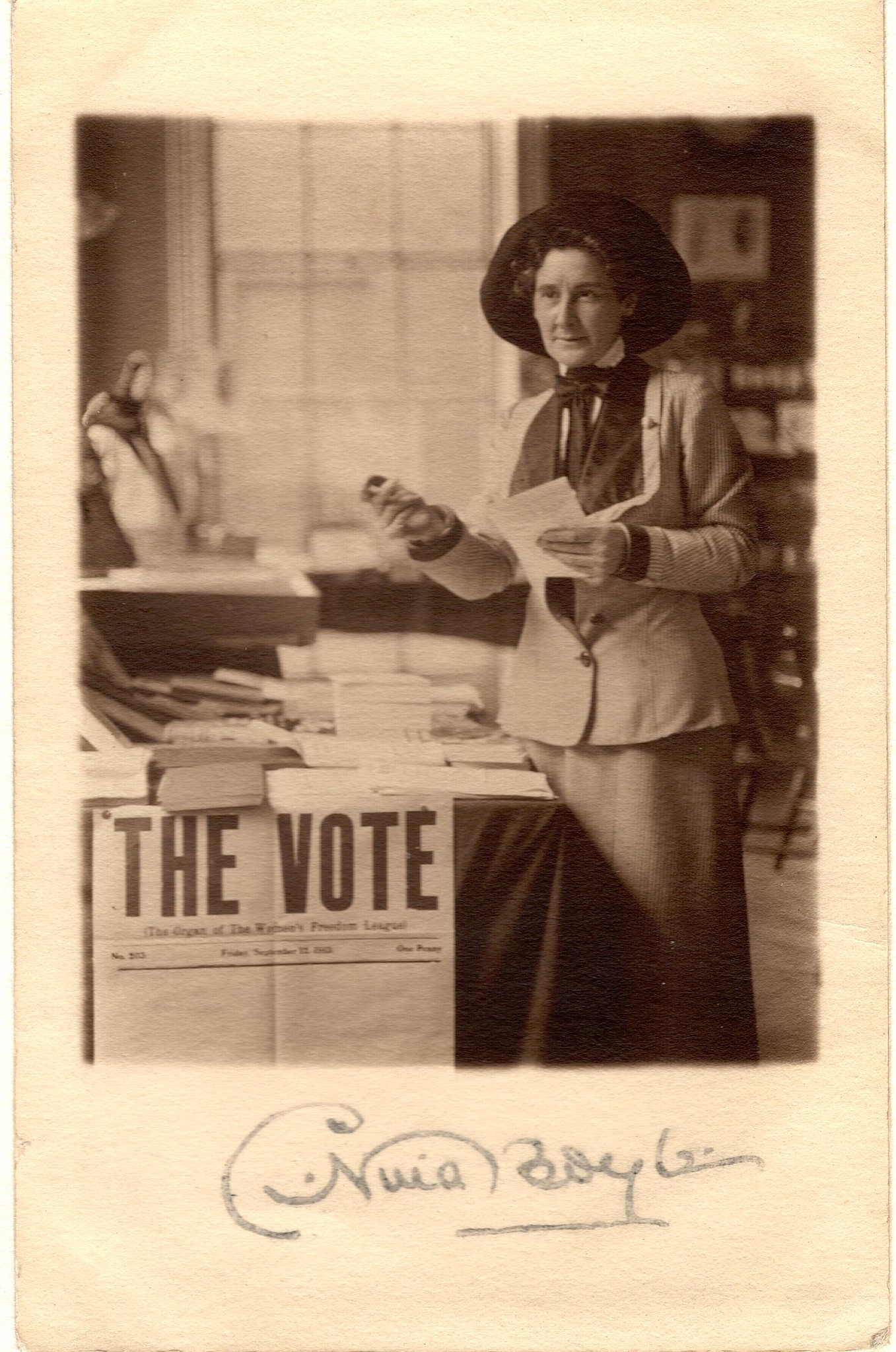 Constance Antonina “Nina” Boyle (December 21, 1865 – March 4, 1943) was a trailblazing British journalist, suffragette, humanitarian, novelist, and
political activist born in Bexley, Kent, on December 21, 1865. Descended from the Earls of Glasgow through her father, Captain Robert Boyle of the Royal
Artillery, and her mother Frances Sydney Fremoult Sankey, she never married and had no children.
Constance Antonina “Nina” Boyle (December 21, 1865 – March 4, 1943) was a trailblazing British journalist, suffragette, humanitarian, novelist, and
political activist born in Bexley, Kent, on December 21, 1865. Descended from the Earls of Glasgow through her father, Captain Robert Boyle of the Royal
Artillery, and her mother Frances Sydney Fremoult Sankey, she never married and had no children.
During the turn of the century, Boyle lived in South Africa, where two of her brothers served in the Boer War. While there, she worked as a journalist
and performed hospital duties, sparking her lifelong dedication to women's rights by founding the Women's Enfranchisement League of Johannesburg. Returning
to Britain in 1911, she initially engaged with the Colonial Intelligence League for Educated Women—headed by Princess Christian—before aligning herself
with the militant yet non-violent Women’s Freedom League (WFL).
As a leading speaker, executive committee member, and eventual secretary of the WFL, Boyle was deeply immersed in civil disobedience. When the 1911
census was conducted, she famously defaced her form at her Westminster flat with the slogan, "No Votes. No Census. Votes for Women". In 1912, she became
the head of the WFL’s political and militant department, writing extensively for its newspaper, The Vote. Arrested on multiple occasions and imprisoned
three times, she utilized her platform alongside court correspondent Edith Watson to expose the brutal injustices
of the male-dominated legal system, highlighting crimes of sexual assault and publishing investigations into human trafficking.
Recognizing that women and girls required female protection within the legal and criminal justice framework, Boyle campaigned for women special
constables at the outbreak of the First World War. When officially rebuffed, she partnered with wealthy philanthropist
Margaret Damer Dawson to establish the Women Police Volunteers (WPV) in 1914. However, ideological
fractures surfaced quickly; in February 1915, Boyle broke away from the organization due to objections over the WPV being deployed to enforce curfews on
women accused of "loose character" near military bases.
Expanding her humanitarian efforts abroad, Boyle traveled to Macedonia and Serbia in late 1916 for hospital and war relief duties, earning the Samaritan
Order of Serbia and the Allied Medal. Following the Russian Revolution, a journey through Russia alongside Lilian Lenton cemented her lifelong
anti-communist stance.
In March 1918, following the death of the Keighley MP, Boyle announced her intention to stand as a WFL candidate for the ensuing by-election. Although
her nomination papers were ultimately rejected on technicalities regarding signatories, the returning officer's initial willingness to accept her
nomination established a critical legal precedent that women were legally eligible to stand for Parliament. This pressure forced Parliament to rapidly pass
the Parliament (Qualification of Women) Act 1918 just prior to the December 1918 general election.
In the post-war decades, Boyle remained an energetic fixture across numerous reform networks, including the Save the Children Fund (SCF)—traveling to
the USSR in 1921 for famine relief while campaigning against sex trafficking—as well as the Open Door Council, the National Union of Women Teachers, and
the Association for Moral and Social Hygiene. Politically, like many ex-suffragettes, she drifted rightward, speaking for bodies like the British Empire
Union and supporting conservative candidates.
Though explicit private records are sparse due to the absence of surviving personal diaries and intimate letters, historical reconstructions by feminist
historians like Katharine Fuller—drawing from oral accounts and contemporaries such as Edith Wall Watson and Philippa Weigall Moore—reveal that Boyle lived
an openly lesbian existence within a dense network of unmarried female reformers. Described by acquaintances as "mannish" or "masculine" in appearance, she
maintained lifelong personal and professional bonds with notable figures like Cicely Hamilton, Edith Watson,
and Eleanor Rathbone.
Nina Boyle passed away at a nursing home on Cromwell Road, London, on March 4, 1943, and was cremated at Golders Green. Her legacy of radical feminism
was honored through the establishment of the Nina Boyle Memorial Fund—chaired by Cicely Hamilton with parliamentary patrons like
Nancy Astor and Ellen Wilkinson—and the creation of the Nina Boyle
Memorial Prize at Bedford College (now Royal Holloway, University of London). Alongside her extensive journalism, she authored a series of popular
adventure and mystery novels featuring strong female protagonists, beginning with Out of the Frying Pan in 1920 and concluding with Good Old Potts! in
1934.
References:
Other references:
- Oxford Dictionary of National Biography (ODNB): Marc Brodie’s entry, "Boyle, Constance Antonina [Nina] (1865–1943), women's rights campaigner", provides a comprehensive academic overview of her life and political career.
- The Women's Suffrage Movement: A Reference Guide, 1866–1928: Elizabeth Crawford’s standard reference text includes a dedicated biographical profile of Nina Boyle (page 75), detailing her leadership within the Women's Freedom League.
- Mapping Women’s Suffrage: Digital mapping projects, such as Oihane Etayo’s profile on [Constance Antonia 'Nina' Boyle], document her census resistance, activism, and residential details.
- Feminist Freikorps: The British Voluntary Women Police, 1914–1940: R. M. Douglas examines the establishment of the Women Police Volunteers (WPV) by Nina Boyle and Margaret Damer Dawson.
- Women Police: Gender, Welfare and Surveillance in the Twentieth Century: Louise Jackson explores the early history of women in British policing, including Boyle's contributions and subsequent organizational splits.
- Women's History Review: Academic articles such as Alison Woodeson’s "The first women police: a force for equality or infringement?" analyze the ideological framework and friction surrounding Boyle's police volunteer initiatives.
- Votes for Women: Research collections edited by June Purvis and Sandra Stanley Holton discuss Boyle's international travels, including her post-revolutionary experiences in Russia.
- The Vote: The official newspaper of the Women's Freedom League features extensive primary writings, articles, and columns authored or co-authored by Nina Boyle and Edith Watson (including columns tracking legal injustices and the treatment of women under the law).
- The Times (London): Contemporary reports track her prominent public appearances, arrests, court protests, speeches, and her pioneering 1918 parliamentary nomination attempt (e.g., reports from April 1918 detailing the Keighley by-election developments).
Support this project
This website is a passion project researched, developed, and funded entirely by me. If you find the content valuable and would like to help support the ongoing research and hosting costs, any contribution is deeply appreciated.
Thank you for keeping this independent resource alive!
My books on Amazon: Elisa Rolle's books
BACK TO HOME PAGE

