Queer Places:
La Pièce de Blé—in Huizen (also known as La Creste), Huiry, 77860 Couilly-Pont-aux-Dames, France
Cimetière de Qunicy-Voisins, 2-4 Rue Carnot, 77860 Quincy-Voisins, France
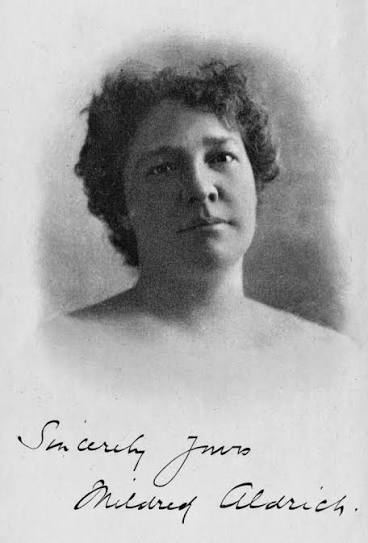 Mildred Aldrich (November 16, 1853 – February 19, 1928) was an American author, journalist, and notable expatriate best remembered for her eyewitness accounts of World War I
and her deep ties to the Parisian avant-garde literary and artistic community.
Mildred Aldrich (November 16, 1853 – February 19, 1928) was an American author, journalist, and notable expatriate best remembered for her eyewitness accounts of World War I
and her deep ties to the Parisian avant-garde literary and artistic community.
Born in Boston, Massachusetts, Aldrich spent her early professional life working as a teacher, a theater critic, and a journalist. She moved in vibrant creative circles,
writing plays and short stories while managing professional relationships with prominent cultural figures of the late 19th and early 20th centuries. In 1898, she permanently
relocated to France, initially working as a journalist and translator in Paris.
In 1914, at the age of 60, Aldrich moved to a modest home—which she named La Pièce de Blé—in Huizen, overlooking the Marne Valley. This rural retreat placed her directly in
the path of the German advance during the opening phases of World War I.
Her detailed, poignant letters to American friends describing the harrowing Battle of the Marne were collected and published as The Hilltop on the Marne (1915). The book
became an international bestseller, establishing her literary reputation overnight. She followed this success with several other memoirs chronicling the wartime years,
including Told in a French Garden (1916) and The Peak of the Load (1918). For her literary propaganda and unwavering moral support for France during its darkest hours, the
French government later honored her with the Legion of Honour.
Within early 20th-century queer historiography and modernist circles, Mildred Aldrich occupies a distinct place. Alongside the American sculptor
Janet Scudder, Aldrich is frequently highlighted as part of a very small, select group of independent lesbian and queer women who
maintained deep, long-term, and egalitarian friendships with Gertrude Stein and
Alice B. Toklas.
While Stein and Toklas's salon at 27 rue de Fleurus hosted many artists and writers, true inner-circle confidantes who shared a mutual understanding of independent
women's lives abroad were rare.
Aldrich and Stein shared a profound mutual respect. Stein actively championed Aldrich’s literary career, lamented when mainstream American publications like The Atlantic
Monthly overlooked Aldrich's cultural contributions, and frequently visited her home on the Marne. Aldrich's home functioned as a vital sanctuary for the creative community
that Stein, Toklas, and their peers navigated.
Like Aldrich, Janet Scudder—a pioneering feminist, suffragette, and expatriate sculptor—forged a lifelong bond with Stein. Scudder's robust independence and artistic
drive mirrored Aldrich's, positioning both women as essential pillars of support, intellectual parity, and enduring loyalty in Stein's immediate social sphere outside
conventional heterosexual structures.
References:
Other references:
- Stein, Gertrude. The Autobiography of Alice B. Toklas. New York: Harcourt, Brace and Company, 1933 (detailing the mutual social circles, friendships, and advocacy involving Mildred Aldrich and Janet Scudder).
- Aldrich, Mildred. The Hilltop on the Marne. Boston: Houghton Mifflin Company, 1915.
- Scudder, Janet. Passing Impressions. New York: Macmillan Publishers, 1925.
- Lynch, Quinn. Expatriate Sappho: Modernist Women Writers and Artists in Paris. Modernism/Modernity Studies, Cambridge University Press.
Support this project
This website is a passion project researched, developed, and funded entirely by me. If you find the content valuable and would like to help support the ongoing research and hosting costs, any contribution is deeply appreciated.
Thank you for keeping this independent resource alive!
My books on Amazon: Elisa Rolle's books
BACK TO HOME PAGE
