Queer Places:
St Matthew Churchyard, Blackmoor Rd, Blackmoor, Liss GU33 6BP, United Kingdom
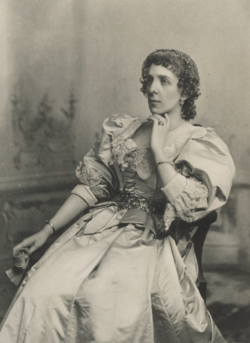 Beatrix Maud Palmer, Countess of Selborne (April 11, 1858 - April 27, 1950), born Lady Maud Gascoyne-Cecil on April 11, 1858, in Marylebone, London, was a prominent British
political organizer, conservative aristocrat, and tireless women's rights activist.
Beatrix Maud Palmer, Countess of Selborne (April 11, 1858 - April 27, 1950), born Lady Maud Gascoyne-Cecil on April 11, 1858, in Marylebone, London, was a prominent British
political organizer, conservative aristocrat, and tireless women's rights activist.
She was born into the heart of the British political establishment as the eldest child of Robert Gascoyne-Cecil, the 3rd Marquess of Salisbury—who later served three
terms as Prime Minister—and his wife, Georgina Alderson. Although she did not receive a formal education, growing up in a politically dominant family immersed her deeply in
Victorian statecraft, conservative philosophy, and grassroots political organizing through the Primrose League.
In October 1883, she married William Palmer, then known as Viscount Wolmer and later the 2nd Earl of Selborne. Together they had four children: Mabel, Roundell, Robert,
and Lewis. Though her husband initially began his parliamentary career as a Liberal, Lady Selborne's staunch conservative convictions strongly influenced his political
evolution; he later broke away to join the Liberal Unionists and held major government roles, including serving as High Commissioner for South Africa from 1905 to 1910. Lady
Selborne accompanied him abroad and dedicated her time to local philanthropic efforts, returning to Britain in 1910 ready to commit herself entirely to the movement for
women's suffrage.
Upon her return, she stepped into formal leadership, serving as the president of the Conservative and Unionist Women's Franchise Association (CUWFA) from 1910 to 1913. In
this role, she traveled extensively across the country, leveraging her high social standing and conservative credentials to argue that women's enfranchisement was entirely
compatible with—and beneficial to—traditional imperial and domestic values. While she initially advocated for votes for women based on existing property qualifications
(which favored wealthier single women), she pragmatically expanded her scope to support the inclusion of married women, famously arguing that the majority of married women
held fundamentally conservative views that would stabilize the electorate. After stepping down from the CUWFA presidency ahead of World War I, she shifted her public focus
toward wartime patriotism and national service. In her later years, she served as a Justice of the Peace in Hampshire and as the president of the National Council of Women
of Great Britain and Ireland from 1920 to 1921. She passed away on April 27, 1950, at the age of ninety-two.
Lady Selborne's lifelong dedication to women's enfranchisement led to her inclusion among the prominent historical figures honored on the public monument dedicated to
Millicent Fawcett in Parliament Square, London, unveiled in 2018. Created by artist Gillian Wearing, the statue
features a plinth inscribed with the names and etched portraits of 59 suffrage supporters—comprising both women and men—who campaigned for equal voting rights. This
coalition on the plinth bridges diverse reform movements of the late 19th and early 20th centuries. Many of the figures immortalized alongside Lady Selborne—such as
Ray Strachey, Philippa Fawcett, and various contemporaries within the broader suffrage
and early sexology reform circles—had deep biographical or ideological intersections with early pioneers of queer liberation, social reform, and the challenging of rigid
Victorian gender binaries. By dismantling restrictions on political participation, figures like Lady Selborne helped lay the foundational legal and social architecture that
later enabled broader intersectional civil rights movements, connecting early-20th-century political enfranchisement directly to the modern history of gender and LGBTQ+
liberation.
References:
- Oxford Dictionary of National Biography (ODNB): Pugh, Martin. "Palmer, (Beatrix) Maud [née Lady (Beatrix) Maud Gascoyne-Cecil], countess of Selborne (1858–1950), suffragist and political wife." Published May 24, 2007 (online edition). Oxford University Press. (The foundational academic biographical entry detailing her lineage, political evolution, and suffragist leadership).
- Glick, Daphne. The National Council of Women of Great Britain: The First Hundred Years, 1895–1994. London: National Council of Women of Great Britain, 1995. (Documents her presidency and organizational leadership following World War I).
- Ridding, Lady Laura. The Life of Robert Palmer 1888–1916. London: Hodder and Stoughton, 1921. (Provides primary domestic and family context regarding her son and immediate aristocratic circle).
- UK Government & Greater London Authority Archives. "Historic statue of suffragist leader Millicent Fawcett unveiled in Parliament Square." Published April 24, 2018 (Gov.uk / The Guardian / iNews archival coverage). (Official documentation covering Gillian Wearing's monument, the selection of the 59 suffrage supporters on the plinth, and historical inclusion criteria).
- Lives of the First World War Memorial Database. Life story entry for Maud Palmer, Lady Selborne. (Cross-references her wartime patriotism, philanthropic campaigns, and Red Cross/Empire relief efforts).
Support this project
This website is a passion project researched, developed, and funded entirely by me. If you find the content valuable and would like to help support the ongoing research and hosting costs, any contribution is deeply appreciated.
Thank you for keeping this independent resource alive!
My books on Amazon: Elisa Rolle's books
BACK TO HOME PAGE