Queer Places:
Rosehill Cemetery, Chicago, Cook County, Illinois, USA
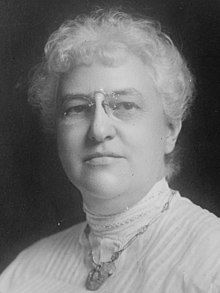 Mary Eliza McDowell (November 30, 1854 – October 14, 1936) was a prominent American social reformer, settlement house director, and labor organizer. Often referred to as the
"Angel of the Stockyards," she dedicated her life to improving the living and working conditions of industrial workers, particularly immigrants and women in Chicago.
Mary Eliza McDowell (November 30, 1854 – October 14, 1936) was a prominent American social reformer, settlement house director, and labor organizer. Often referred to as the
"Angel of the Stockyards," she dedicated her life to improving the living and working conditions of industrial workers, particularly immigrants and women in Chicago.
Born in Cincinnati, Ohio, McDowell moved to Chicago with her family in 1870. Raised in a devout Methodist household, she began her civic work in the 1880s organizing
youth groups and kindergartens for the Woman's Christian Temperance Union.
She soon became the kindergarten teacher at Jane Addams's famous Hull House, which served as a hub for social reformers. In 1894,
McDowell took charge of the University of Chicago Settlement House in the "Back of the Yards" neighborhood, an area predominantly inhabited by Irish, German, Bohemian, and
Polish families who worked in the nearby meatpacking plants. Under her leadership, the settlement became a vital community center, offering English classes, a gymnasium, a
kindergarten, and a playground.
McDowell was fiercely committed to trade unionism. During the bitter packinghouse strikes of 1904 and 1921, she was a staunch supporter and interpreter of the union
cause.
In 1903, McDowell joined forces with other labor advocates at an American Federation of Labor convention to establish the Women's Trade Union League (WTUL). The WTUL was
a unique organization that brought together working-class women and upper-class "allies" to lobby for protective legislation, women's suffrage, and vocational
education.
McDowell worked closely with other prominent reformers in the WTUL, including:
Jane Addams: Served as vice president of the WTUL and hosted its early meetings at Hull House.
Margaret Dreier Robins: A wealthy philanthropist who devoted her professional life to the organization, serving as its
leader and financing its monthly journal, Life and Labor.
Agnes Nestor & Mary Anderson: Prominent working-class trade unionists whom McDowell
helped recruit into the battle for shorter hours and safer conditions.
The personal lives of McDowell and her peers were deeply intertwined with their professional reform work. At the turn of the twentieth century, educated women who chose
to pursue active public careers often opted to forego heterosexual marriage.
Instead, many of these reformers formed intense, lifelong partnerships with other professional women. This phenomenon was so common in upper-class and educated circles
that such arrangements became known colloquially as "Boston marriages"—a term popularized by Henry James's 1886 novel The Bostonians.
Women in these relationships lived as long-term companions, sharing their homes, finances, and lives. Jane Addams, for example, lived in such a relationship with her partner
Mary Rozet Smith for forty years.
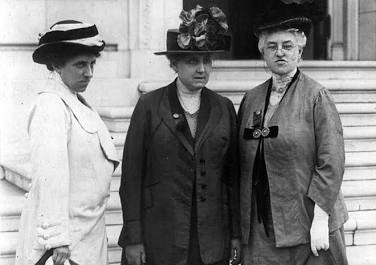
Lathrop, Addams, and McDowell, 1913
McDowell, Addams, and Julia Lathrop—who ran the Plato Club at Hull House and campaigned heavily for child protection laws—were
part of a close-knit network of unmarried women who supported each other's civic and personal lives. A notable symbol of their enduring personal and political bond was their
joint 1913 suffrage trip to Capitol Hill. None of the three women ever married, dedicating their lives instead to social reform and the community they built with one
another.
References:
Other references:
- The Encyclopedia of Chicago (Chicago Historical Society): Details the formation and impact of the Women's Trade Union League (WTUL). It documents McDowell's uneasy but effective alliance with civic reformers like Jane Addams and Margaret Dreier Robins, as well as working-class trade unionists such as Agnes Nestor and Mary Anderson.
- Social Welfare History Project (Virginia Commonwealth University): Provides a comprehensive biography of McDowell's early life, her founding of the University of Chicago Settlement House, and her lasting title as the "Angel of the Stockyards".
- Encyclopedia.com (Notable American Women & Famous American Women): Covers her broader civic impact, including her 1923 appointment as Chicago's Commissioner of Public Welfare, her establishment of the Interracial Cooperative Committee following the 1919 race riots, and her work alongside Frances Willard in the Women's Christian Temperance Union.
- Spartacus Educational & EBSCO Research Starters: Further chronicles the WTUL's history, noting Margaret Dreier Robins's role in financing its monthly journal, Life and Labor, and the close-knit network of reformers that included McDowell, Addams, and Lillian Wald.
- "Revolt, They Said" (Museum of Modern Art Project) & Progressive Era Historical Analyses: Projects and historical analyses detailing the networks of early 20th-century female reformers often discuss the prevalence of the "Boston Marriage". In these upper-class and professional circles, women frequently lived together and supported each other financially and emotionally in lifelong partnerships, which was both common and accepted by society at the time.
Support this project
This website is a passion project researched, developed, and funded entirely by me. If you find the content valuable and would like to help support the ongoing research and hosting costs, any contribution is deeply appreciated.
Thank you for keeping this independent resource alive!
My books on Amazon: Elisa Rolle's books
BACK TO HOME PAGE

