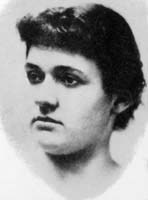
 Mary Trimble Lawrence (December 28, 1867 – March 14, 1945) was a celebrated American sculptor and cultural patron whose life bridged Gilded Age artistic
circles and the development of historic Sneden's Landing.
Mary Trimble Lawrence (December 28, 1867 – March 14, 1945) was a celebrated American sculptor and cultural patron whose life bridged Gilded Age artistic
circles and the development of historic Sneden's Landing.Queer Places:
Cliffside, Lawrence Ln, Orangetown, NY 10964, USA
Académie Julian, Passage des Panoramas, 75002 Paris
Woodlawn Cemetery, Bronx, Bronx County, New York, USA
Mary Trimble Lawrence (December 28, 1867 – March 14, 1945) was a celebrated American sculptor and cultural patron whose life bridged Gilded Age artistic
circles and the development of historic Sneden's Landing.
Born in New York City to a prominent family with deep American lineage—including colonial mayor John Lawrence and War of 1812 hero Captain James Lawrence—she grew up on her family's estate, "Cliffside," in what is now Palisades, New York. Showing an early and uncommon artistic talent, she began studying drawing and sculpture under the legendary Augustus Saint-Gaudens at just seven years old, eventually spending five years as his pupil at the Art Students League of New York and later serving as his trusted studio assistant.
Lawrence achieved national recognition when Saint-Gaudens recommended her to create the monumental statue of Christopher Columbus for the entrance of the Administration Building at the 1893 World's Columbian Exposition in Chicago. Despite encountering professional opposition from fair organizers who doubted a young woman's capacity for such a massive undertaking, Saint-Gaudens fiercely defended her work, crediting her entirely for its vitality and breadth. Following the exposition, she continued her training in Paris at the Académie Julian, where she immersed herself in avant-garde artistic circles, met Auguste Rodin, and built enduring connections within the international art community.
In Paris, she met François Michel Louis Tonetti, a fellow sculptor and assistant to Frederick William MacMonnies. Despite warnings from her mentor Saint-Gaudens—who feared marriage would extinguish her artistic career—and her family's preference for other suitors, she married Tonetti in 1900. While she produced fewer large-scale independent works after marriage, she collaborated with her husband on significant commissions, such as fountains for the 1901 Pan-American Exposition and statues for the U.S. Customs House in New York, while raising their children. Following François's death in 1920, she transitioned to living year-round at Sneden's Landing, where she played a pivotal role as one of the founders of New York's Cosmopolitan Club and transformed her ancestral home into a thriving, secluded haven for artists, writers, and actors.
Though Mary Lawrence Tonetti was married to a man and raised a family, her later years and her historic enclave at Sneden's Landing became deeply entwined with prominent queer figures of the 20th century. Most notably, she formed a profound, decades-long romantic friendship with legendary theatrical actress Katharine Cornell. Cornell first visited Sneden's Landing at the invitation of Mary's daughter, Anne Tonetti (later Gugler), but quickly became utterly captivated by the older, dynamic Mary Tonetti.
Historians and contemporaries, including Cornell's longtime secretary and executive producer Gertrude Macy, noted that Cornell "fell for Marie Tonetti right away." The two women maintained an intensely devoted relationship that lasted until Tonetti's death in 1945, frequently exchanging deeply affectionate letters when apart. Sneden's Landing offered Cornell—a fiercely private and intensely focused person—a safe, creative sanctuary cultivated specifically by Tonetti. Through this nurturing environment, Tonetti inadvertently helped foster a legendary safe harbor that would welcome generations of prominent artists, securing her legacy not only as a master sculptor and pioneer of American art colonies, but as a central figure in the personal and professional lives of mid-century artistic icons.
References:
Support this project
This website is a passion project researched, developed, and funded entirely by me. If you find the content valuable and would like to help support the ongoing research and hosting costs, any contribution is deeply appreciated.
Thank you for keeping this independent resource alive!
My books on Amazon: Elisa Rolle's books