Queer Places:
Sevres Communal Cemetery, 42-44 Rue de la Garenne, 92310 Sèvres, France
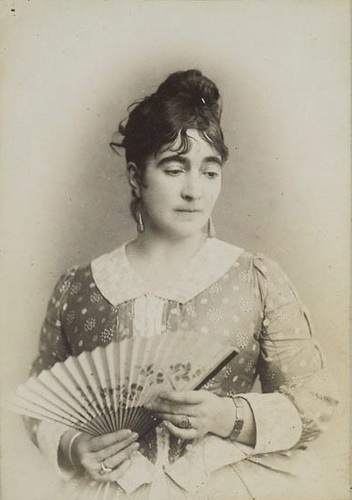 Marie Bracquemond (December 1, 1840 – January 17, 1916) is widely remembered as one of the most expressive, yet tragically stifled, talents of the Impressionist movement.
Alongside Mary Cassatt and Berthe Morisot, she was famously dubbed one of “les trois
grandes dames” (the three great ladies) of Impressionism by the art critic Gustave Geffroy in 1894.
Marie Bracquemond (December 1, 1840 – January 17, 1916) is widely remembered as one of the most expressive, yet tragically stifled, talents of the Impressionist movement.
Alongside Mary Cassatt and Berthe Morisot, she was famously dubbed one of “les trois
grandes dames” (the three great ladies) of Impressionism by the art critic Gustave Geffroy in 1894.
While her career was cut short by domestic oppression, her surviving vibrant, light-filled canvases secure her place in the avant-garde canon.
Born Marie Anne Caroline Quivoron on December 1, 1840, in Argenton-en-Landunvez, Brittany, she did not enjoy the wealthy, cultured upbringing of her female Impressionist
contemporaries. Her father, a sea captain, died shortly after her birth. Her mother remarried quickly, leading the family through an unsettled, nomadic childhood across
France and Switzerland before finally settling in Étampes, south of Paris.
Largely self-taught, Marie began formal drawing lessons in her teens under a local restoration artist, Auguste Wassor. Her immense natural talent became clear when, at
just 16 years old, her painting of her mother and sister was accepted into the prestigious Paris Salon of 1857.
This success earned her an introduction to the towering neoclassical master Jean-Auguste-Dominique Ingres. She joined his private studio but quickly grew frustrated by
his dismissive attitude toward women, writing:
"The severity of Monsieur Ingres frightened me... because he doubted the courage and perseverance of a woman in the field of painting... He would assign to them only the
painting of flowers, of fruits, of still lives."
Marie left Ingres' studio to chart her own path, securing high-profile commissions, including a painting from the court of Empress Eugénie.
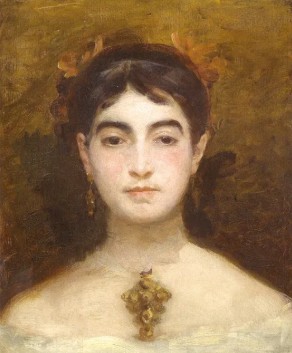
Self-portrait
While working as a copyist of Old Masters in the Louvre, Marie met Félix Bracquemond, a highly successful engraver, etcher, and ceramics director. They married in 1869,
and in 1870, she gave birth to their only child, Pierre.
Through Félix, Marie was introduced to the progressive art world of Paris, collaborating with him on ceramic designs for the Haviland studio. More importantly, she met
her husband's friends: Edgar Degas, Claude Monet, and Paul Gauguin.
Interacting with these artists transformed her style. She abandoned the tight, polished academic realism of her youth and embraced Impressionism. She moved her easel
outdoors (en plein air), lightened her palette to vibrant, intense colors, and began experimenting with the effects of shifting sunlight. She proudly exhibited her work in
the Impressionist exhibitions of 1879, 1880, and 1886.
Tragically, Marie’s artistic breakthrough became a source of severe marital friction. Félix grew deeply resentful of his wife's talent and heavily disapproved of
Impressionism, preferring traditional, structured black-and-white printmaking. He routinely belittled her work, hid her paintings from visitors, and subjected her to
relentless emotional criticism.
Worn down by the toxic household friction and suffering from delicate health, Marie made a heartbreaking sacrifice for the sake of domestic peace. Around 1890, she
effectively put down her brushes and ceased painting publicly, retreating into anonymity. She passed away on January 17, 1916, in Sèvres.
Marie Bracquemond and Mary Cassatt shared a profound historical connection, though their lives and careers were defined by starkly contrasting circumstances. Rather
than an intimate, daily friendship, their relationship was one of artistic parallel, mutual validation, and shared struggle within a male-dominated art world.
The most direct personal and artistic bridge between Bracquemond and Cassatt was Edgar Degas. Degas acted as a mentor and champion for both women.
In 1874, a drawing Bracquemond presented at the Salon caught Degas’ eye, prompting him to introduce her to the core Impressionist group. In 1877, Degas famously
recognized Cassatt’s genius at the Salon and invited her to join the movement.
Because Degas fiercely advocated for both women, Bracquemond and Cassatt found themselves operating in the same progressive avant-garde inner circle, frequently viewing,
critiquing, and inspiring each other's submissions during the landmark 1879 and 1880 exhibitions.
Because 19th-century social codes barred respectable women from exploring the gritty Parisian nightlife (such as the bars and dance halls painted by Monet or
Toulouse-Lautrec), both Bracquemond and Cassatt mastered the domestic sphere. They painted intimate portrayals of women, children, and localized nature—Cassatt focus
leaned toward internal domesticity and mother-child bonds, while Bracquemond masterfully captured middle-class women in lush, sunlit home gardens (such as On the Terrace
at Sèvres).
Furthermore, both women shared a deep fascination with Japonisme (the influence of Japanese art on Western aesthetics). Bracquemond brilliantly integrated Japanese
asymmetry and clean lines into her Haviland ceramic dinnerware and paintings, while Cassatt famously channeled Japanese woodblock prints into her revolutionary color
etchings.
Ultimately, while Mary Cassatt had the wealth and independence to fight openly for her place in art history, Marie Bracquemond was a reclusive prisoner of her domestic
situation. Nonetheless, their side-by-side inclusion in the Impressionist exhibitions proved to the 19th-century art world that women were not merely peripheral copyists,
but core innovators of modern art.
References:
- https://www.encyclopedia.com/women/encyclopedias-almanacs-transcripts-and-maps/bracquemond-marie-1840-1916
- https://artuk.org/discover/stories/marie-bracquemond-and-the-welcome-rediscovery-of-women-artists
- https://en.wikipedia.org/wiki/Marie_Bracquemond
- https://www.tuttartpitturasculturapoesiamusica.com/2015/03/Marie-Bracquemond.html
- https://www.arthistoryproject.com/artists/marie-bracquemond/
- https://artuk.org/discover/stories/marie-bracquemond-and-the-welcome-rediscovery-of-women-artists
- https://impressionistsgallery.co.uk/artists/Artists/abc/Bracquemond/biography.html
- https://www.theartstory.org/artist/bracquemond-marie/
Support this project
This website is a passion project researched, developed, and funded entirely by me. If you find the content valuable and would like to help support the ongoing research and hosting costs, any contribution is deeply appreciated.
Thank you for keeping this independent resource alive!
My books on Amazon: Elisa Rolle's books
BACK TO HOME PAGE