Queer Places:
Cimetière d'Ivry, 44 Av. de Verdun, 94200 Ivry-sur-Seine, France
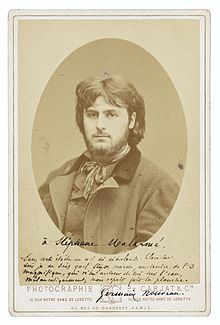 Lucien Létinois (February, 1860 - 1883) was born in February 1860 in France. He grew up as an ordinary provincial youth until his path crossed with the troubled and renowned
French Symbolist poet Paul Verlaine. In October 1877, Verlaine took a position teaching English and literature at an institution in
Rethel within the Ardennes region, where Létinois was enrolled as a student. What began as a traditional student-teacher dynamic rapidly evolved into a deeply intimate and
romantic partnership. This connection occurred following the complete collapse of Verlaine's volatile, internationally infamous affair with fellow poet
Arthur Rimbaud. Having separated permanently from Rimbaud after shooting him in a Brussels hotel room and serving a prison
sentence, Verlaine found in Létinois a powerful emotional and physical surrogate. Contemporaries noted that Létinois bore a striking physical and behavioral resemblance to
Rimbaud, sharing his build, regional accent, and intense gaze, which heavily fueled Verlaine's romantic fixation.
Lucien Létinois (February, 1860 - 1883) was born in February 1860 in France. He grew up as an ordinary provincial youth until his path crossed with the troubled and renowned
French Symbolist poet Paul Verlaine. In October 1877, Verlaine took a position teaching English and literature at an institution in
Rethel within the Ardennes region, where Létinois was enrolled as a student. What began as a traditional student-teacher dynamic rapidly evolved into a deeply intimate and
romantic partnership. This connection occurred following the complete collapse of Verlaine's volatile, internationally infamous affair with fellow poet
Arthur Rimbaud. Having separated permanently from Rimbaud after shooting him in a Brussels hotel room and serving a prison
sentence, Verlaine found in Létinois a powerful emotional and physical surrogate. Contemporaries noted that Létinois bore a striking physical and behavioral resemblance to
Rimbaud, sharing his build, regional accent, and intense gaze, which heavily fueled Verlaine's romantic fixation.
Seeking a quiet life together away from societal judgment, Verlaine and Létinois traveled to England in 1879, where Létinois secured employment in Stickney while Verlaine
taught nearby. Returning to France in 1880, Verlaine used his remaining funds to purchase a agricultural farm in the Ardennes, intending to settle down permanently with
Létinois and integrate Létinois's parents into the domestic arrangement. However, due to poor financial management, mounting debts, and lack of agricultural success, the
farm venture completely collapsed. Following the failure of the enterprise, Létinois was required to leave to fulfill his mandatory military service, stationed nearby in
Reims, while Verlaine moved around before eventually heading back to Paris.
The military separation was short-lived, but tragedy struck shortly after they reunited in Paris. In April 1883, Lucien Létinois contracted typhoid fever and died
abruptly at the age of 23. His sudden death devastated Verlaine, plunging the older poet into profound grief, severe depression, and a renewed descent into heavy alcoholism.
Létinois's profound impact on Verlaine's life is immortalized in Verlaine's poetry, notably within collections like Sagesse, where the grief-stricken author memorialized the
young man's voice, laughter, and untimely passing, cementing Létinois's place in the history of LGBTQ+ literary figures.
References:
Other references:
- Paul Verlaine's poetry collections, specifically Sagesse (1881) and Amour (1888), which contain extensive sequences and elegies dedicated to and mourning Lucien Létinois.
- Biographies and biographical studies on Paul Verlaine (such as accounts detailing his life in Rethel, the farming venture in the Ardennes, and his time in England).
- Memoir and biographical recollections by contemporaries of Paul Verlaine, including commentary and descriptions by François-Achille Cazals regarding Létinois's physical and personal resemblance to Arthur Rimbaud.
- Archival and literary documentation concerning French Symbolist poets, tracking Létinois's role as a student at the institution in Rethel, his military service, and his untimely death from typhoid in April 1883.
Support this project
This website is a passion project researched, developed, and funded entirely by me. If you find the content valuable and would like to help support the ongoing research and hosting costs, any contribution is deeply appreciated.
Thank you for keeping this independent resource alive!
My books on Amazon: Elisa Rolle's books
BACK TO HOME PAGE