Queer Places:
1 E 66th St, New York, NY 10065, USA
Green-Wood Cemetery, Greenwood Heights, Kings County, New York, USA
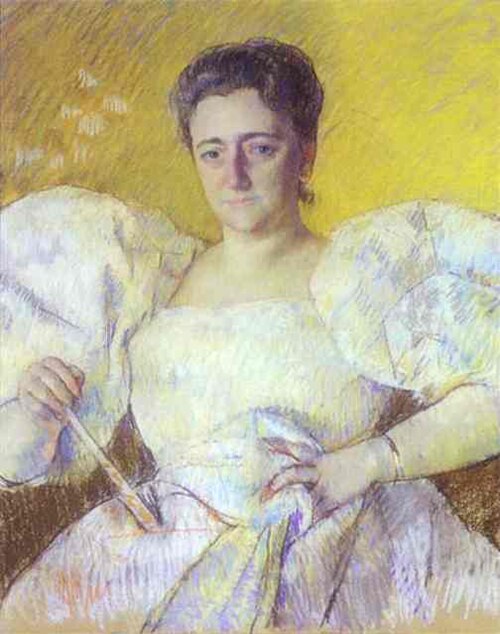 Louisine Waldron Elder Havemeyer (July 28, 1855 – January 6, 1929) was a pioneering American art collector, philanthropist, and radical women's suffrage activist. Alongside
her husband, sugar tycoon Henry Osborne Havemeyer, she assembled one of the most formidable private art collections in the United States, playing a fundamental role in
introducing French Impressionism to the American public.
Louisine Waldron Elder Havemeyer (July 28, 1855 – January 6, 1929) was a pioneering American art collector, philanthropist, and radical women's suffrage activist. Alongside
her husband, sugar tycoon Henry Osborne Havemeyer, she assembled one of the most formidable private art collections in the United States, playing a fundamental role in
introducing French Impressionism to the American public.
Born in New York City to merchant George W. Elder and Matilda Adelaide Waldron, Louisine developed an early and passionate interest in modern art. While finishing her
education at a boarding school in Paris run by Mme. Del Sarte, she met the American expatriate artist Mary Cassatt in 1877 through
mutual friends.
Cassatt became a lifelong mentor, close friend, and ideological guide. Under Cassatt's tutelage, Louisine made her very first independent art purchase at age 21: a pastel
by Edgar Degas. This marked the beginning of a lifelong collecting partnership focused heavily on Degas, Claude Monet, Édouard Manet, and Gustave Courbet.
In 1883, Louisine married Henry Osborne Havemeyer. Sharing a bold aesthetic vision—and substantial wealth—the couple aggressively acquired works that defied conservative
American tastes of the era. Advised continuously by Mary Cassatt, they filled their Fifth Avenue mansion with European Impressionism, Post-Impressionism, ancient artifacts,
Islamic art, and Asian antiquities.
Following her husband's death in 1907, Louisine continued to expand and manage the collection. She later bequeathed a vast portion of the Havemeyer Bequest to the
Metropolitan Museum of Art, fundamentally shaping its permanent holdings of European masterpieces.
In her later years, Havemeyer redirected her formidable energy and resources toward the fight for women's suffrage. She joined the radical wing of the movement, helping
Alice Paul found the National Woman's Party.
She famously organized major fundraising exhibitions using her private art collection at Knoedler’s Gallery in New York (in 1912 and 1915), charging admission to benefit
the suffrage cause.
She participated in high-profile protests, marched down Fifth Avenue, toured the country speaking on the "Prison Special," and was arrested and imprisoned in 1917 after
picketing the White House, where she partook in a hunger strike.
While Louisine Havemeyer was a married mother of three who lived within a traditional heterosexual framework, her life, social network, and historical framing intersect
significantly with early feminist and queer historiography, particularly through her deep bonds with pioneering unmarried women.
Louisine’s lifelong bond with Mary Cassatt is central to her legacy. Cassatt never married, choosing instead to prioritize her professional career as an artist and her
independence in a male-dominated art world.
In studies of late 19th- and early 20th-century women, intense, primary life-long partnerships between women—such as the "Boston marriages" or deeply committed platonic
life partnerships—frequently overlap with queer history. While Cassatt and Havemeyer were close friends and patrons bound by art, their relationship exemplifies the
profound, female-centric emotional and professional networks that bypassed traditional patriarchal structures. Cassatt's lifelong independence and rejection of conventional
domesticity provided a blueprint for the liberated, activist paths Havemeyer later took in both art collecting and politics.
Lillie P. Bliss was a prominent art collector, patron, and one of the core founders of the Museum of Modern Art (MoMA) in New
York. Along with Mary Quinn Sullivan and Abby Aldrich Rockefeller, Bliss formed a triad of female visionaries who shaped modern art institutions.
Bliss belonged directly to Louisine Havemeyer’s broader elite social circle of pioneering female tastemakers and financial patrons who revolutionized the American art
market. Like Cassatt, Lillie P. Bliss was an unmarried woman, embodying the independent female household models common among high-society women patrons of the era. Havemeyer
paved the early path for women like Bliss, proving that female collectors could single-handedly dictate national artistic tastes independent of male institutional oversight.
References:
- Havemeyer, Louisine W. Sixteen to Sixty: Memoirs of a Collector. New York: Metropolitan Museum of Art, 1961.
- Havemeyer, Louisine W. "The Prison Special: Memories of a Militant." Scribner’s Magazine, vol. 71, no. 5, May 1922, pp. 531–545.
- Havemeyer, Louisine W. "The Suffrage Torch: Memories of a Militant." Scribner’s Magazine, vol. 71, no. 6, June 1922, pp. 528–538.
- Weitzenhoffer, Frances. The Havemeyers: Impressionism Comes to America. New York: Harry N. Abrams, 1986.
- Metropolitan Museum of Art. Splendid Legacy: The Havemeyer Collection. New York: The Metropolitan Museum of Art, 1993.
- Harris, Neil. "Louisine Waldron Elder Havemeyer." Notable American Women, 1607–1950: Volume II: G-O, edited by Edward T. James, Janet Wilson James, and Paul S. Boyer, Harvard University Press, 1971, pp. 156–158.
- The Metropolitan Museum of Art (The Havemeyer Bequest): Archival documentation regarding the 1929 donation of over 140 works of art.
- The Museum of Modern Art (MoMA) Archives: Records concerning Lillie P. Bliss (1864–1931), foundational documents, and the Lillie P. Bliss Collection exhibition catalogues.
- National Gallery of Art: Online biographical records detailing Louisine Waldron Elder Havemeyer's lineage, European travels, and introduction to French Impressionism.
Support this project
This website is a passion project researched, developed, and funded entirely by me. If you find the content valuable and would like to help support the ongoing research and hosting costs, any contribution is deeply appreciated.
Thank you for keeping this independent resource alive!
My books on Amazon: Elisa Rolle's books
BACK TO HOME PAGE