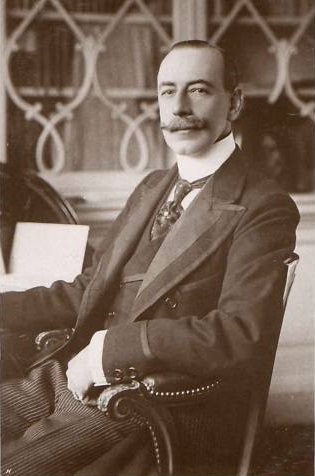
 Lewis Vernon Harcourt, 1st Viscount Harcourt, PC (born Reginald Vernon Harcourt; January 31, 1863 - February 24, 1922), widely known throughout his life by
the nickname "Loulou", was a prominent British Liberal Party politician.
Lewis Vernon Harcourt, 1st Viscount Harcourt, PC (born Reginald Vernon Harcourt; January 31, 1863 - February 24, 1922), widely known throughout his life by
the nickname "Loulou", was a prominent British Liberal Party politician.Queer Places:
Nuneham Estate, Nuneham Park, Oxford OX44 9PG, United Kingdom
Eton College, Windsor SL4 6DW, United Kingdom
University of Oxford, Oxford, Oxfordshire OX1 3PA
69 Brook St, London W1K 4ER, UK
All Saints Old Church, Nuneham Courtenay, Oxford OX44 9PQ, United Kingdom
Lewis Vernon Harcourt, 1st Viscount Harcourt, PC (born Reginald Vernon Harcourt; January 31, 1863 - February 24, 1922), widely known throughout his life by
the nickname "Loulou", was a prominent British Liberal Party politician.
Born at Nuneham Courtenay, Oxfordshire, he was the only surviving son of the notable Liberal statesman Sir William Vernon Harcourt and his first wife, Maria Theresa Lister. Because his mother died shortly after his birth, Harcourt developed an exceptionally close and protective lifelong relationship with his father, eventually serving as his confidential private secretary for over two decades. He was educated at Eton College and later studied Doctor of Civil Law at the University of Oxford. As a wealthy landowner, he inherited the lordships of the manors of Stanton Harcourt, Nuneham Courtenay, North Hinksey, Cogges, Northmoor, and Shifford.
Harcourt’s political career closely mirrored his father's trajectory. He served as private secretary to Sir William during his tenure as Home Secretary from 1880 to 1885, and subsequently when his father served as Chancellor of the Exchequer in 1886 and from 1892 to 1895. In 1904, Harcourt entered the House of Commons as the Liberal Member of Parliament for Rossendale, Lancashire, holding the seat until 1916. He joined Sir Henry Campbell-Bannerman’s ministry as First Commissioner of Works in 1905, entered the Cabinet in 1907, and retained his post under H.H. Asquith until 1910, returning to the portfolio later from 1915 to 1916. During his time leading the Office of Works, he authorized the placement of the Peter Pan statue in Kensington Gardens in 1912 and laid plans for the rebuilding of Piccadilly Circus. From 1910 to 1915, he served as the Secretary of State for the Colonies in Asquith's Cabinet. Politically, while he supported progressive causes such as land reform, social security, and minimum wage provisions, he was an outspoken opponent of women's suffrage—drawing the ire of activists whose protests led to his Berkeley Square home windows being smashed in 1911—and a fierce critic of David Lloyd George's "People's Budget". In 1917, he was raised to the peerage as Viscount Harcourt of Stanton Harcourt.
Outside of parliamentary politics, Harcourt maintained active cultural and environmental interests. He acted as a trustee for major national institutions including the British Museum, the Wallace Collection, the National Portrait Gallery, and the London Museum—the latter of which he helped establish alongside Reginald Brett, 2nd Viscount Esher, opening in March 1912. An advocate for natural history preservation, he received an honorary DCL from Oxford and an honorary fellowship from the Royal Institute of British Architects. His name was cemented in global geography when the newly established port city in southern Nigeria was named Port Harcourt after him in 1913 following correspondence with Governor-General Sir Frederick Lugard. In his personal life, he married Mary Ethel Burns—daughter of American banker Walter Hayes Burns and niece of financier J.P. Morgan—on July 1, 1899. The couple had four children: Doris, Olivia, Barbara, and William, who succeeded him as the 2nd Viscount Harcourt.
Beneath his distinguished public exterior, Harcourt was widely known in elite London society as a sexual predator whose aggressive advances toward young people of both genders were an open secret. Contemporaries noted his uninhibited behavior, and household precautions at weekend parties often involved junior guests having servants block their doors to prevent uninvited late-night intrusions. His targets allegedly included Dorothy Brett, daughter of Lord Esher, who later characterized him as a "sex maniac" driven by an ungovernable desire rather than affection.
Harcourt died suddenly in his sleep on February 24, 1922, at his London townhouse at 69 Brook Street, at the age of 59. His death followed an overdose of Bromidia, a prescription sleeping draught. While an official inquest recorded a verdict of death by misadventure linked to heart disease and pulmonary edema, intense societal rumors of suicide circulated following emergent accusations of sexual impropriety involving a young Etonian, Edward James. Despite these dark private scandals remaining largely concealed from the general public for decades, Harcourt's legacy remains deeply intertwined with the complex interpersonal dynamics, elite public school networks, and hidden transgressions of the late Victorian and Edwardian political establishment.
References:
Support this project
This website is a passion project researched, developed, and funded entirely by me. If you find the content valuable and would like to help support the ongoing research and hosting costs, any contribution is deeply appreciated.
Thank you for keeping this independent resource alive!
My books on Amazon: Elisa Rolle's books