Queer Places:
Salem Fields Cemetery, 775 Jamaica Ave, Brooklyn, NY 11208, United States
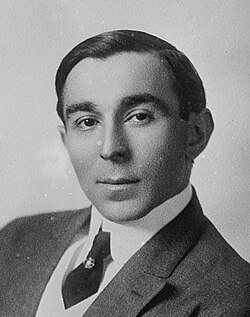 Lee Shubert (March 25, 1871 – December 25, 1953), born Levi Schubart on March 25, 1871, in Vladislavov, Congress Poland (now Kudirkos Naumiestis,
Lithuania), grew up in a Jewish family headed by his parents, Duvvid (David Hersh) Schubart and Katrina (Gittel "Catherine") Helwitz. At the age of
eleven, he emigrated with his family to the United States, settling in Syracuse, New York, where an established community of immigrants from their
hometown lived. The family faced severe financial hardship due to his father's alcoholism, prompting a young Shubert to support them by selling
newspapers on street corners. Driven by ambition and utilizing borrowed money, he and his younger brothers, Sam and Jacob, launched a business venture
that successfully acquired and operated several theaters across upstate New York.
Lee Shubert (March 25, 1871 – December 25, 1953), born Levi Schubart on March 25, 1871, in Vladislavov, Congress Poland (now Kudirkos Naumiestis,
Lithuania), grew up in a Jewish family headed by his parents, Duvvid (David Hersh) Schubart and Katrina (Gittel "Catherine") Helwitz. At the age of
eleven, he emigrated with his family to the United States, settling in Syracuse, New York, where an established community of immigrants from their
hometown lived. The family faced severe financial hardship due to his father's alcoholism, prompting a young Shubert to support them by selling
newspapers on street corners. Driven by ambition and utilizing borrowed money, he and his younger brothers, Sam and Jacob, launched a business venture
that successfully acquired and operated several theaters across upstate New York.
Seeking a larger stage for their ambitions, the brothers expanded to New York City in March 1900 by leasing the Herald Square Theatre. While Jacob
stayed behind to manage their upstate operations, Lee and Sam moved to Manhattan, laying the groundwork for what would evolve into the largest theatrical
empire of the twentieth century. To counter the dominant and exclusionary Theatrical Syndicate, the Shuberts boldly staged productions in rented circus
tents that accommodated massive crowds. In 1910, they spearheaded the Independent National Theatre Owner's Association, successfully convincing theaters
nationwide to defect from the Syndicate. By 1922, Shubert had solidified his power, reaching a working agreement with his former rival
A. L. Erlanger.
Known as a hard-nosed, formidable businessman, Shubert focused heavily on commercial methods and financial stability rather than pure culture,
building an empire that eventually encompassed iconic venues such as the Winter Garden, Shubert, and Imperial theaters. His aggressive business tactics
included banning critical reviewers from his theaters—a practice so contentious it ultimately prompted changes to New York State law. Despite his
reputation for cutthroat business dealings, he possessed a keen eye for top-tier talent, famously convincing French megastar
Sarah Bernhardt to return to America in 1905 after she had sworn never to perform there again. Under his
leadership, the Shubert stages featured legendary performers like Eddie Cantor, Al Jolson, Fred and
Adele Astaire, and Cary Grant, alongside major productions such as the
Ziegfeld Follies and Cole Porter's You Never Know.
Regarding his personal life, Shubert was married to Marcella Swanson, a former actress significantly younger than him. The couple married secretly in
Berlin in July 1936, divorced in Reno in September 1948, and remarried in Miami in March 1949. In addition to his conventional marriage, historical and
biographical records, including claims by costume designer George James Hopkins, note LGBTQ links within
his broader creative circle, suggesting that Melville Ellis—a dashing designer for the Shuberts—served as Lee
Shubert's lover. Shubert amassed a massive fortune, boasting an estate worth $16 million at the time of his death. He passed away in Manhattan on
December 25, 1953, at the age of 82, and was interred in the family plot at Salem Fields Cemetery in Brooklyn, leaving behind a legacy that cemented the
Shubert Organization as the preeminent theater owner on Broadway.
References:
Other references:
- The Shubert Archive – The official repository housing extensive institutional records, correspondence, financial papers, and photographs detailing the lives and careers of Lee, Sam, and Jacob Shubert.
- The New York Times – Contemporary reporting, including his obituary ("Lee Shubert Dies in Hospital," December 26, 1953) and archival coverage of his business dealings, marriages, and legal disputes.
- The Brothers Shubert by Jerry Stagg (Random House, 1968) – A foundational dual-biography and history of the family enterprise.
- The Boys from Syracuse: The Shuberts' Theatrical Empire by Foster Hirsch (Cooper Square Press, 2000) – An in-depth look at their theatrical monopoly, business practices, and rise to power.
- The Shuberts and Their Passing Shows: The Untold Tale of Ziegfeld's Rivals by Jonas Westover (Oxford University Press, 2016) – Focuses on their theatrical productions and competition within the industry.
- The Shuberts of Broadway: A History Drawn from the Collections of the Shubert Archive by Brooks McNamara (Oxford University Press, 1990) – An illustrated and documented history utilizing primary sources from the Shubert Archive.
- Shuberts Present: One Hundred Years of Great American Theatre by Maryann Chach (Harry N. Abrams, 2001) – A centennial celebration of the organization's architectural and theatrical footprint.
- Dictionary of American Biography – Contains standard academic entries and career overviews for Lee Shubert.
- Encyclopædia Britannica – Concise biographical profiles covering the Shubert brothers and their impact on American theatrical management.
- PBS: Broadway: The American Musical – Educational documentation and broadcast resources regarding the Shubert family's role in shaping early American theater.
Support this project
This website is a passion project researched, developed, and funded entirely by me. If you find the content valuable and would like to help support the ongoing research and hosting costs, any contribution is deeply appreciated.
Thank you for keeping this independent resource alive!
My books on Amazon: Elisa Rolle's books
BACK TO HOME PAGE