Queer Places:
Schloss Liebenberg, Parkweg 1, 16775 Löwenberger Land, Germany
Bernarda Pretficza 24, 53-407 Wrocław, Poland
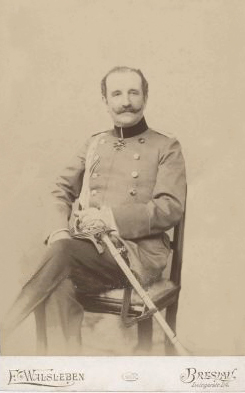 Lieutenant General Kuno Augustus Friedrich Karl Detlev Graf von Moltke (December 13, 1847 – March 19, 1923) was a Prussian military officer, composer, wing adjutant to
Kaiser Wilhelm II, and the military commandant of Berlin. Today, he is primarily remembered as a central figure
in the Harden-Eulenburg Affair (1907–1909), widely considered the largest homosexual scandal of Imperial Germany and a watershed moment in LGBTQ history.
Lieutenant General Kuno Augustus Friedrich Karl Detlev Graf von Moltke (December 13, 1847 – March 19, 1923) was a Prussian military officer, composer, wing adjutant to
Kaiser Wilhelm II, and the military commandant of Berlin. Today, he is primarily remembered as a central figure
in the Harden-Eulenburg Affair (1907–1909), widely considered the largest homosexual scandal of Imperial Germany and a watershed moment in LGBTQ history.
Born in Neustrelitz into the illustrious Mecklenburg branch of the von Moltke nobility—which included his uncle, the famed Field Marshal Helmuth von Moltke the
Elder—Kuno was naturally steered toward a prestigious military career. He received his commission in the Prussian Guard Artillery in 1867, served in the Franco-Prussian
War, and steadily advanced through the ranks.
By the late 1890s, he had risen to become a Generalleutnant (Lieutenant General) and the city commandant of Berlin. He became a deeply integrated member of the
Liebenberg Round Table, an elite, tightly knit circle of aristocrats, artists, and diplomats who served as the closest advisors and confidants to Kaiser Wilhelm II.
Considered a "confirmed bachelor" well into middle age, Moltke surprised court society in 1896 by marrying Nathalie "Lilly" von Hayden, a woman more than twenty years
his junior. The marriage was a disaster and ended in divorce in 1902.
Rumors immediately circulated within elite Berlin circles regarding the reasons for the breakdown, with many whispering that Moltke possessed an intense emotional
detachment from women. In truth, Moltke’s deepest emotional and romantic bonds were reserved for men, most notably the leader of the Liebenberg circle,
Philipp, Prince of Eulenburg.
The scandal broke in 1906 when the influential, crusading journalist Maximilian Harden published a series of articles in his magazine Die Zukunft ("The Future").
Harden, who fiercely opposed the moderate, anti-imperialist foreign policy of the Liebenberg Circle, sought to politically dismantle the Kaiser’s advisors. He chose to do
so by exploiting Paragraph 175, the German penal code that criminalized homosexual acts between men.
Using thinly veiled pseudonyms, Harden outed Moltke as "Sweetie" (Süßchen) and Eulenburg as "The Harpist," publishing excerpts of their private correspondence. The
letters revealed an intensely intimate, romantic, and effusive relationship—they referred to each other by affectionate nicknames and used terms of endearment to
describe the Kaiser (such as Liebchen, or "darling"). To the public, the language was indistinguishable from that of a passionate heterosexual love affair.
When the Kaiser found out about the impending public exposure, he demanded the immediate resignation of Moltke and several other high-ranking officials. While Prince
Eulenburg initially fled to Switzerland to wait out the storm, Moltke—seeking to clear his name and salvage his military honor—challenged Harden to a duel. When Harden
refused, Moltke sued him for civil libel in 1907.
The resulting trial became a public sensation and featured historic, dramatic testimonies:
Lilly von Hayden (Moltke’s ex-wife) took the stand voluntarily to testify against him. In highly publicized, sexually explicit testimony that shocked conservative
Germany, she described a complete lack of conjugal relations after the first two nights of marriage, stating that Moltke spent all his time and affection on Eulenburg.
She famously testified that her husband had placed a pan of cold water between them in bed to discourage intimacy, while actively treasuring a handkerchief belonging to
Eulenburg.
The pioneering sexologist and early LGBTQ rights advocate Dr. Magnus Hirschfeld was called as an expert witness.
Hirschfeld observed Moltke in court and testified that based on his mannerisms and emotional makeup, Moltke possessed a "feminine side" and was fundamentally homosexual,
even if he had never physically violated Paragraph 175.
The court initially ruled in Harden’s favor, concluding that the journalist had spoken the truth regarding Moltke's sexuality. However, the Prussian political machine
was horrified by the verdict. The trial was voided on procedural grounds, and a subsequent criminal retrial in 1908 found Harden guilty of libel. Despite the legal
reversal, the damage to the elite "camarilla" was total.
Forced into early, permanent retirement, Kuno von Moltke spent the remainder of his life entirely removed from public and military affairs. He moved to Breslau
(modern-day Wrocław, Poland), where he died on March 19, 1923, at the age of 75.
The Kaiser-Wilhelm-Straße (now ulica Powstańców Śląskich), a grand boulevard that ran through the military and upscale residential quarters where high-ranking officers
typically resided and where a massive monument dedicated to his famous uncle, Field Marshal Helmuth von Moltke, stood during Kuno's lifetime. The Moltke Monument was
last located on what was then Hardenbergstraße (today: ulica Bernarda Pretficza ). The monument was unveiled on October 26, 1899. It depicts the general standing with
his left arm bent. In the 1930s, it was moved from the former Kaiser-Wilhelm-Straße to Hardenbergstraße due to the construction of a new tram line. After World War II,
the bronze figure was melted down. The monument's base still exists today. The inscription ( Moltke 1800–1891 ) has been removed. A soldier sculpture now stands on the
base next to the building at ulica Bernarda Pretficza 24.
Historically, Moltke’s forced outing and subsequent trials had profound cultural consequences. The scandal forced homosexuality out of the shadows of medical journals
and into the mainstream German consciousness for the very first time. While it initially triggered a wave of homophobia, it also laid the groundwork for modern, public
debates regarding legal reform and sexual identity in the early 20th century.
References:
Other references:
- https://grokipedia.com/page/Kuno_von_Moltke
- https://en.wikipedia.org/wiki/Eulenburg_affair
- https://en.wikipedia.org/wiki/Kuno_von_Moltke
- https://www.ebsco.com/research-starters/history/emperor-william-iis-homosexual-circle-scandalizes-germany
- http://prussianmachine.com/prussia/moltke_kuno.htm
- https://adp.library.ucsb.edu/index.php/mastertalent/detail/115222/Moltke_Kuno_Graf_von
Support this project
This website is a passion project researched, developed, and funded entirely by me. If you find the content valuable and would like to help support the ongoing research and hosting costs, any contribution is deeply appreciated.
Thank you for keeping this independent resource alive!
My books on Amazon: Elisa Rolle's books
BACK TO HOME PAGE