Queer Places:
Harrow School, 5 High St, Harrow HA1 3HP, United Kingdom
Tighnabruaich PA21 2BD, United Kingdom
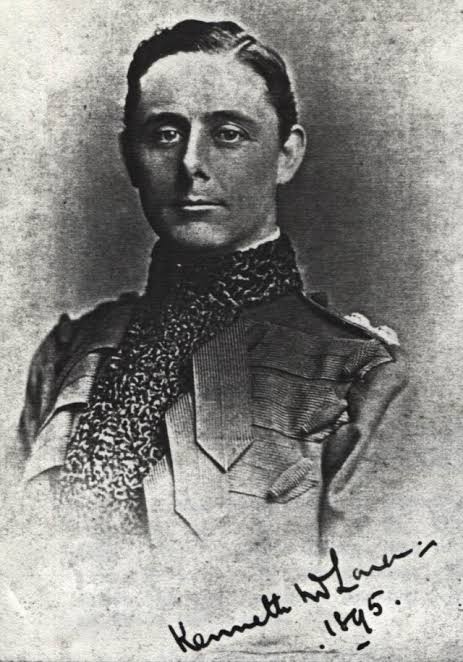 Kenneth McLaren (May 31, 1860 – July 23, 1924) was born on May 31, 1860. Educated at Harrow before passing through Sandhurst, he embarked on a distinguished military career
that led him to join the 13th Hussars. Initially drawn together by McLaren's grief following the death of his mother, he and
Robert Baden-Powell first met around 1881 in Afghanistan. Struck by his youthful appearance, Baden-Powell affectionately
nicknamed him "the boy McLaren." The two officers soon moved on to postings together in India, forging a deep and lasting bond. During these years, they hunted wild boar
together—an activity Baden-Powell described as "pigsticking"—and McLaren distinguished himself as an exceptional polo player, representing the Hussars in numerous
competitions. When the regiment returned to Britain in 1886, Baden-Powell traveled with McLaren to Scotland on leave, initiating a warmth toward Scotland that would
influence Baden-Powell's later life and the early development of Scouting.
Kenneth McLaren (May 31, 1860 – July 23, 1924) was born on May 31, 1860. Educated at Harrow before passing through Sandhurst, he embarked on a distinguished military career
that led him to join the 13th Hussars. Initially drawn together by McLaren's grief following the death of his mother, he and
Robert Baden-Powell first met around 1881 in Afghanistan. Struck by his youthful appearance, Baden-Powell affectionately
nicknamed him "the boy McLaren." The two officers soon moved on to postings together in India, forging a deep and lasting bond. During these years, they hunted wild boar
together—an activity Baden-Powell described as "pigsticking"—and McLaren distinguished himself as an exceptional polo player, representing the Hussars in numerous
competitions. When the regiment returned to Britain in 1886, Baden-Powell traveled with McLaren to Scotland on leave, initiating a warmth toward Scotland that would
influence Baden-Powell's later life and the early development of Scouting.
Over the next twenty years, McLaren became a central figure in Baden-Powell's life, described by Baden-Powell as "my best friend in all the world." In 1898, McLaren
married Leila Evelyn Landon, the daughter of an army officer. However, at Baden-Powell's request, McLaren left his heavily pregnant wife in 1899 to campaign in Africa,
joining him at Mafeking where McLaren was seriously wounded and spent the final six weeks of the siege in a Boer hospital. His daughter, Eilean, was born in October 1899,
and Baden-Powell became her godfather. In 1901, McLaren worked for Baden-Powell once more as his London-based recruitment officer for the South African Constabulary. When
Leila tragically died at age 29 in 1904, Baden-Powell supported his friend through his grief.
McLaren's influence on the Scouting movement was foundational. When Baden-Powell planned his experimental camp on Brownsea Island in 1907, he called upon McLaren to help,
and McLaren attended the historic gathering. In December of that year, McLaren became the first secretary—or manager—of the Boy Scouts. However, his tenure lasted only three
months, as he struggled to get along with the management of C.A. Pearson, Baden-Powell's publisher and backer. Baden-Powell did not intervene, a hesitation possibly
influenced by McLaren's intention to remarry.
Baden-Powell strongly disapproved of McLaren's developing relationship with Ethel Mary Wilson, his late wife's former nurse, whom Baden-Powell considered to be beneath
McLaren's social standing. Despite this disapproval, the pair married in 1910; Baden-Powell did not attend the wedding, and the two friends began to drift apart. When
Baden-Powell married Olave Soames in 1912, McLaren was not invited, and Ethel proved prone to intense jealousy regarding
Baden-Powell's former friendships.
Throughout his life, McLaren suffered from chronic depression, referred to at the time as a "softening of the brain," which was diagnosed in 1910. Despite this, he
volunteered for administrative service in France in 1914. His final years were marked by severe health struggles, spending six years in either the Camberwel House Asylum or
a private mental hospital in Herefordshire before his death on July 23, 1924. Baden-Powell did not attend the funeral. Much of their history was initially lost to
obscurity—aside from some discussion by author Tim Jeal in the 1990s—and the hundreds of letters exchanged between the two friends were seemingly destroyed by wives after
their deaths. However, a portion survived: in 1965, a tea chest discovered at a Glasgow auction contained letters from Baden-Powell to McLaren written while McLaren was
wounded at Mafeking, which are now preserved in the Scottish Scout archive.
Following his death, McLaren was laid to rest beside his mother, Elizabeth McLaren, on a hillside in Argyll, Scotland. Situated in a magnificent location looking out to
sea, his grave lies within a walled enclosure beneath a granite Celtic cross. Ethel kept on McLaren's house in Argyll and later bought a smaller home in the same village,
eventually passing away in 1967 a decade after the death of Eilean. Today, the neglected burial enclosure has become overgrown with yew trees, damaging the boundary walls
and threatening McLaren's headstone—a quiet, melancholy legacy for a man who played an instrumental role in the life of Robert Baden-Powell and the early creation of a
global Scouting movement.
References:
- Gayday by Massimo Consoli, 2005
- Jeal, Tim. Baden-Powell: Founder of the Boy Scouts. London: Hutchinson, 1989. (The definitive biographical work containing primary analytical discussion of Robert Baden-Powell and Kenneth McLaren's relationship, diaries, and correspondence).
- Barrett, C. R. B. History of the XIII Hussars. Edinburgh: William Blackwood and Sons, 1911. (Provides official military documentation regarding McLaren’s service record, deployments to India, and actions during the Second Boer War).
- The Cavalry Journal, Volume 15. "Obituary: Major Kenneth McLaren." (Periodical record capturing contemporary military notices and professional framing of his career upon his passing in 1924).
- The Harrow School Register, 1845–1925 (Second Series, edited by John Hubert Stogdon). Longmans, Green & Co. (Archival educational records documenting his early schooling and background).
- The Scout Association Archive / Scottish Scout Archives. (Holdings containing surviving correspondence, photographs, and the historical tea-chest rediscovery of letters sent by Baden-Powell to McLaren during the Siege of Mafeking).
Support this project
This website is a passion project researched, developed, and funded entirely by me. If you find the content valuable and would like to help support the ongoing research and hosting costs, any contribution is deeply appreciated.
Thank you for keeping this independent resource alive!
My books on Amazon: Elisa Rolle's books
BACK TO HOME PAGE