Partner W. Graham Robertson
Queer Places:
16 Phillimore Pl, London W8 7BU, UK
Holywell Cemetery, 10 St.Cross Rd, Oxford OX1 3TU, United Kingdom
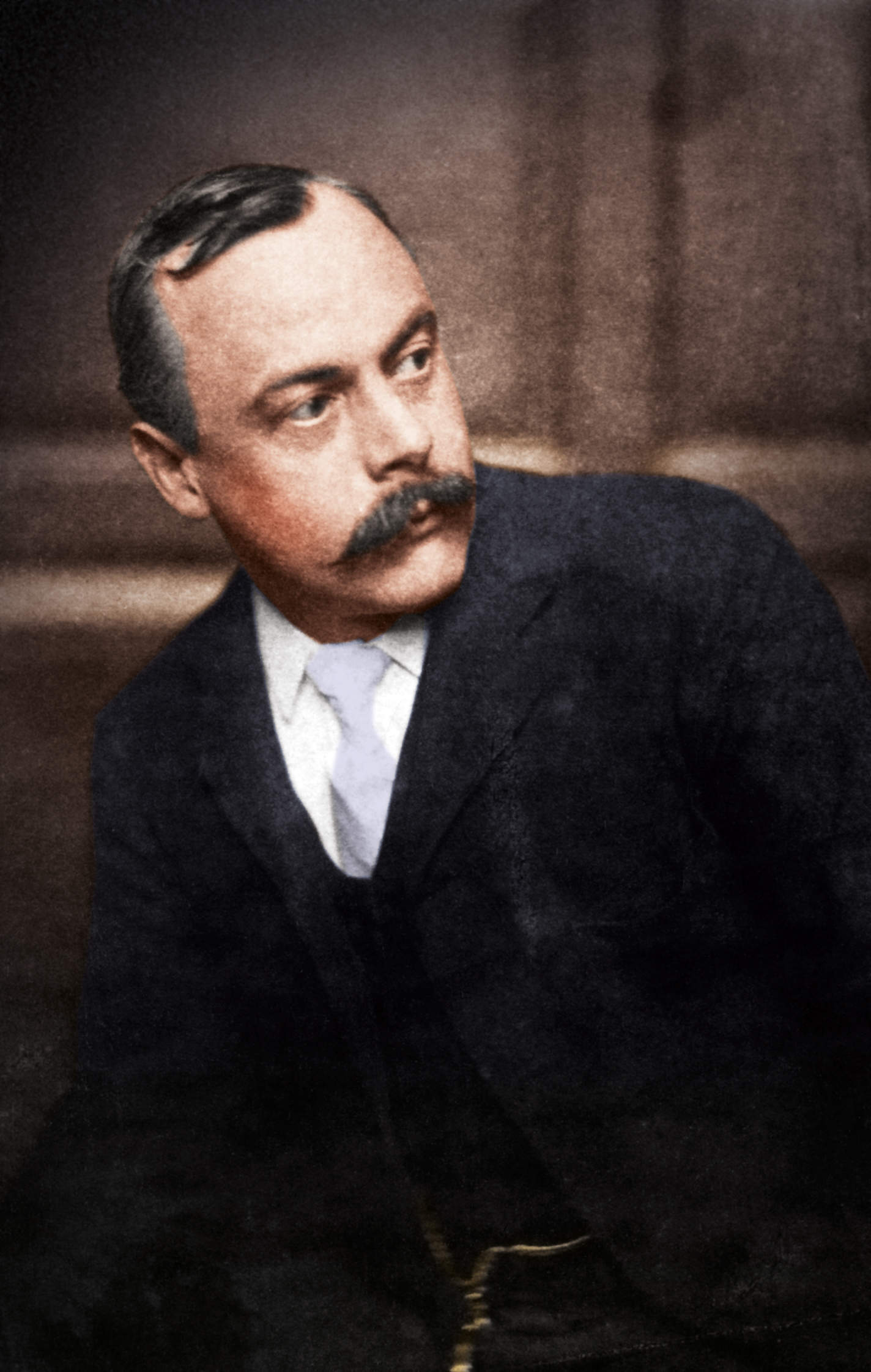 Kenneth Grahame (March 8, 1859 – July 6, 1932) was born on 8 March 1859 in Edinburgh, Scotland, the son of an advocate, and spent much of an unsettled childhood being raised
by his grandmother in Berkshire following the death of his mother and his father's struggles with alcohol. Though a brilliant student at St Edward's School in Oxford with
deep aspirations of attending the university, financial constraints and family opposition barred him from higher education. Instead, he entered the workforce, eventually
securing a position at the Bank of England in 1879 where he enjoyed a long and distinguished corporate career, ultimately rising to become the bank's Secretary in 1898.
Alongside his demanding financial profession, Grahame pursued a literary path, contributing essays and sketches to prominent periodicals like the National Observer and The
Yellow Book. His early publications, including Pagan Papers (1893), The Golden Age (1895), and Dream Days (1898), celebrated the imaginative landscape of youth and
established his literary reputation. In 1899, he entered into an increasingly unhappy marriage with Elspeth Thomson, with whom he had a single son, Alastair. Following
health struggles and an incident wherein he survived a shooting at the bank, Grahame retired in 1908, the same year he published his masterwork, The Wind in the Willows. The
later years of his life were heavily shadowed by melancholy and tragedy, most notably the death of his son Alastair at Oxford in 1920. Kenneth Grahame died on 6 July 1932 in
Pangbourne and was buried in Oxford.
Kenneth Grahame (March 8, 1859 – July 6, 1932) was born on 8 March 1859 in Edinburgh, Scotland, the son of an advocate, and spent much of an unsettled childhood being raised
by his grandmother in Berkshire following the death of his mother and his father's struggles with alcohol. Though a brilliant student at St Edward's School in Oxford with
deep aspirations of attending the university, financial constraints and family opposition barred him from higher education. Instead, he entered the workforce, eventually
securing a position at the Bank of England in 1879 where he enjoyed a long and distinguished corporate career, ultimately rising to become the bank's Secretary in 1898.
Alongside his demanding financial profession, Grahame pursued a literary path, contributing essays and sketches to prominent periodicals like the National Observer and The
Yellow Book. His early publications, including Pagan Papers (1893), The Golden Age (1895), and Dream Days (1898), celebrated the imaginative landscape of youth and
established his literary reputation. In 1899, he entered into an increasingly unhappy marriage with Elspeth Thomson, with whom he had a single son, Alastair. Following
health struggles and an incident wherein he survived a shooting at the bank, Grahame retired in 1908, the same year he published his masterwork, The Wind in the Willows. The
later years of his life were heavily shadowed by melancholy and tragedy, most notably the death of his son Alastair at Oxford in 1920. Kenneth Grahame died on 6 July 1932 in
Pangbourne and was buried in Oxford.
The atmospheric and structural makeup of Grahame's personal life and masterwork bear fascinating intersections with queer history and homosocial aestheticism, most
notably through his close connection to the artist and writer W. Graham Robertson. During his decades working as a banker in
London, Grahame lived a compartmentalized life, spending his weekdays sharing a residence with Robertson while maintaining his domestic arrangement with his wife and son in
the countryside on weekends—a domestic fluidity reflective of late-Victorian and Edwardian homosocial subcultures. This environment heavily influenced The Wind in the
Willows (1908), a text famously devoid of prominent female figures, where women are pushed to the absolute periphery as unseen or non-speaking entities. Within Grahame's
pastoral creation, bachelor animals construct domestic routines together, mark their unions with gifts like dressing-gowns, and fiercely protect their emotional independence
under codes of absolute privacy. Beyond this insulated domesticity lies an expansive world of social institutions, prisons, and foreign ports of call stretching toward
Constantinople and the Greek islands, all anchored by the mythological, pan-like deity of the Piper at the Gates of Dawn, whose shaggy, muscular form evokes an intense,
trembling devotion between male companions that transcends simple friendship.
References:
Other references:
- Kenneth Grahame: A Biography by Peter Green (1959 / revised edition as Beyond the Wild Wood: The World of Kenneth Grahame, 1982) – The definitive biographical work examining Grahame’s internal psychology, financial career, and marriage.
- First Friend: A Life of Kenneth Grahame by Denis Chalmers Higgins (1974) – A focused biographical study drawing heavily on personal papers and letters.
- Kenneth Grahame by Alison Prince (1994) – A modern critical biography exploring his life, artistic circles, and the tragedy surrounding his son Alastair.
- The Kenneth Grahame Life, Letters and Unpublished Work edited by Patrick Chalmers (1933) – An early collection containing biographical narrative, correspondence, and rare fragments.
- Time Was by W. Graham Robertson (1931) – The illustrated memoir by Grahame's close friend and companion, offering extensive context on late-Victorian artistic circles, London living arrangements, and aestheticism.
- The Wind in the Willows: A Children's Literature Study and academic commentary by Professor Peter Hunt – Explores the domestic subcultures, homosocial dynamics, and spatial structures of Grahame's writing.
Support this project
This website is a passion project researched, developed, and funded entirely by me. If you find the content valuable and would like to help support the ongoing research and hosting costs, any contribution is deeply appreciated.
Thank you for keeping this independent resource alive!
My books on Amazon: Elisa Rolle's books
BACK TO HOME PAGE
