Queer Places:
Garnisons Kirkegård, Dag Hammarskjölds Allé 10, 2100 København, Denmark
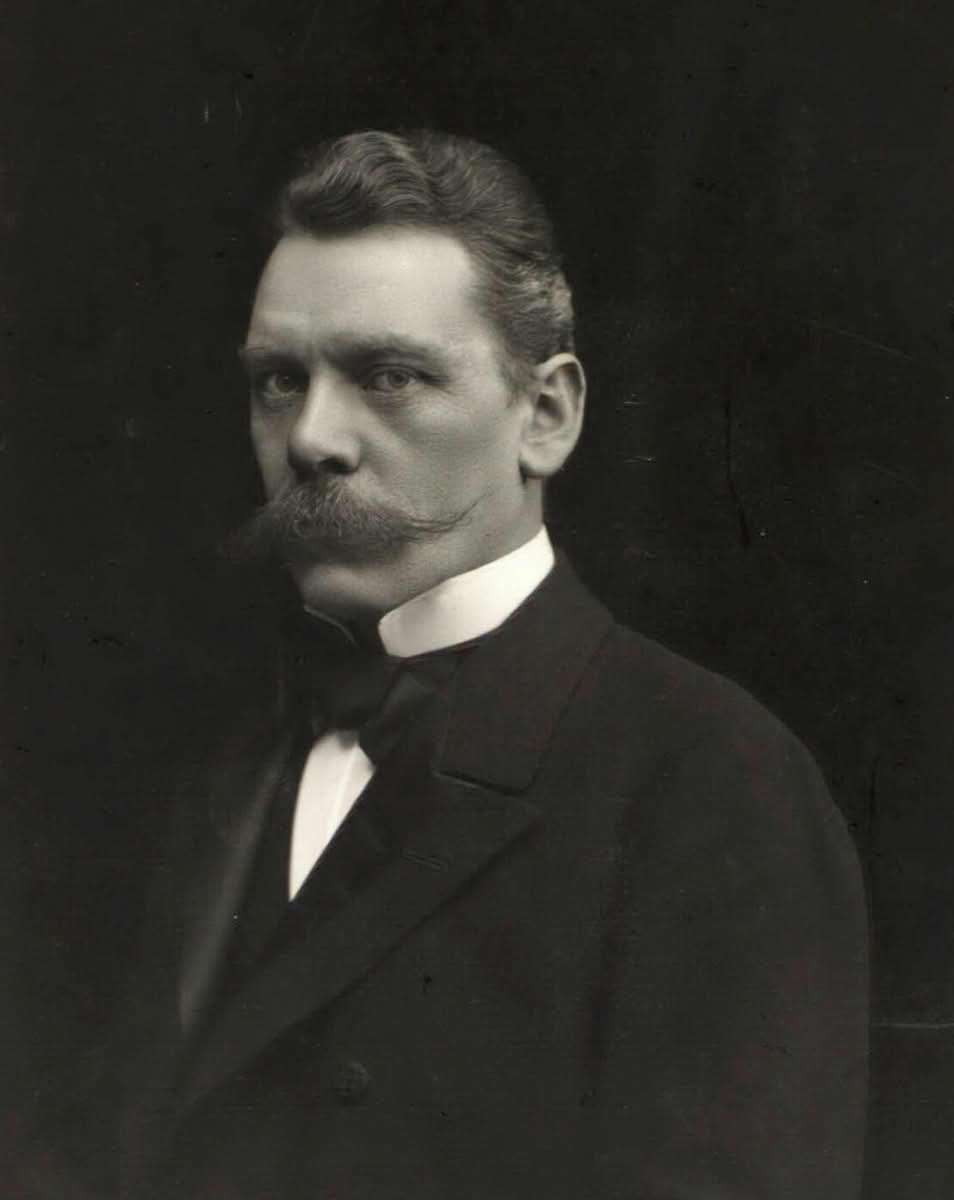 Karl Halfdan Eduard Larsen (July 28, 1860 – July 11, 1931) was a prominent Danish author and journalist born in Rendsburg, Schleswig-Holstein. Growing up in the
tension-filled borderland between Danish and German cultures—his father perished as an officer at the Battle of Dybbøl in 1864—Larsen later leaned toward German mentalities
and militarism following an extended stay in Germany. This national alignment, demonstrated in works like the play Ære (1892) and patriotic tracts such as Dommens Dag (1908)
and Japansk Aand (1909), ultimately generated political friction and social isolation, particularly during World War I. Before these controversies, Larsen achieved
widespread popularity for his sharp, realistic depictions of Copenhagen life, capturing both the bourgeoisie and lower social strata with linguistic precision and slang in
collections like Udenfor Rangklasserne (1896) and novels such as Kresjan Vesterbro (1897) and I det gamle Voldkvarter (1899). His broad literary output also encompassed
psychological studies of women, identity works like Doktor Ix (1896), travel writing, and polemical essays.
Karl Halfdan Eduard Larsen (July 28, 1860 – July 11, 1931) was a prominent Danish author and journalist born in Rendsburg, Schleswig-Holstein. Growing up in the
tension-filled borderland between Danish and German cultures—his father perished as an officer at the Battle of Dybbøl in 1864—Larsen later leaned toward German mentalities
and militarism following an extended stay in Germany. This national alignment, demonstrated in works like the play Ære (1892) and patriotic tracts such as Dommens Dag (1908)
and Japansk Aand (1909), ultimately generated political friction and social isolation, particularly during World War I. Before these controversies, Larsen achieved
widespread popularity for his sharp, realistic depictions of Copenhagen life, capturing both the bourgeoisie and lower social strata with linguistic precision and slang in
collections like Udenfor Rangklasserne (1896) and novels such as Kresjan Vesterbro (1897) and I det gamle Voldkvarter (1899). His broad literary output also encompassed
psychological studies of women, identity works like Doktor Ix (1896), travel writing, and polemical essays.
Larsen's historical and literary footprint intersects significantly with early LGBTQ history primarily through his close association with the Danish writer
Joachim Reinhard. Reinhard belonged to Denmark's first generation of publicly scrutinized homosexual men, having fled to the
United States twice following severe public and university scandals tied to his sexuality. Reinhard and Larsen maintained a lasting correspondence, with a large collection
of Reinhard's letters to Larsen—as well as to Arthur Feddersen—being preserved to document the social pressures faced
by homosexual individuals at the time.
Drawing heavily from his connection to Reinhard and the wider literary circles of the era, Larsen anonymously published a small German novel titled Daniel/Daniela: Aus
dem Tagebuch eines Kreuzträgers in 1908 (later published under his own name in Danish in 1922). Framed as a fictionalized diary, the book served as a psychological portrait
of a homosexual librarian modeled closely after Reinhard. While German reviewers initially accepted it as an authentic, tragic self-confession of a gay man bearing a social
cross, Larsen explained in his later Danish preface that the book was a pastiche meant to contribute to public discourse rather than an expression of personal sympathy. In
addition to Reinhard, Larsen's early life intersected with the famous author Herman Bang—who had previously used Larsen as a literary
model in works like Haabløse Slægter and Stuk—though the two eventually experienced a falling out, partly complicating the publication of Larsen's biographical projects due
to recognizable portraits.
References:
- Dansk Biografisk Leksikon (3rd edition, 1979–1984; entry on Karl Larsen by Carl Dumreicher).
- Dansk Forfatterleksikon: Biografier (edited by John Chr. Jørgensen, Rosinante, 2001).
- Gads Danske Forfatterleksikon (Gad).
- Jesper Düring Jørgensen, Den smilende kamæleon. Karl Larsen (1860-1931) - digter, journalist, militarist (biographical and critical study).
- Karl Larsen, autobiographical sketch in Forfatterbogen (1898).
- Karl Larsen, Midt i og mod strømmen (1930)—includes the republished essay "Hvorledes jeg arbejder" (originally published in Tilskueren, 1904).
- Christian Rimestad, Digtere i forhør (1906).
- Original manuscripts, personal papers, and correspondence (including letters exchanged with Joachim Reinhard and Arthur Feddersen) preserved in The Royal Library, Copenhagen (Det Kongelige Bibliotek).
Support this project
This website is a passion project researched, developed, and funded entirely by me. If you find the content valuable and would like to help support the ongoing research and hosting costs, any contribution is deeply appreciated.
Thank you for keeping this independent resource alive!
My books on Amazon: Elisa Rolle's books
BACK TO HOME PAGE