Queer Places:
Lingnerschloss, Bautzner Str. 132, 01099 Dresden-Loschwitz, Germany
Schloss Tarasp, Sparsels 145, 7553 Tarasp, Switzerland
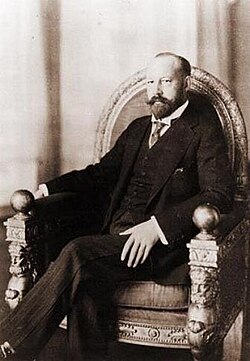 Karl August Ferdinand Lingner (December 21, 1861 - June 5, 1916) was born on December 21, 1861, in Magdeburg, Germany, as the third son of a merchant. He attended the city's
Higher Trade School before moving to Gardelegen in the Mark Brandenburg region at the age of fifteen to work as a shop assistant. In 1883, Lingner moved to Paris with the
ambition of studying music at the Paris Conservatoire and working as a sales representative for German companies. When those plans failed and left him penniless, he returned
to Germany in 1885 and settled in Dresden, where he found employment as a correspondent at the Seidel & Naumann sewing machine factory.
In 1888, Lingner founded the company Lingner & Kraft alongside engineer Georg Wilhelm Kraft in a humble garden shed on Wölfnitzstraße, producing novelty items such as
back scratchers, steel rulers, and pen cleaners before Kraft departed in 1892. Following several years of research, his friend and chemist Richard Seifert offered him an
antiseptic formula in 1891 or 1892, capitalizing on the emerging field of bacteriology. Recognizing that the oral cavity was the main entry point for pathogenic bacteria,
Lingner produced "Odol"—derived from the Greek word for tooth and the Latin word for oil—which met a massive public demand for protection against invisible germs and sold
exceptionally well. On October 3, 1892, he founded the Dresden Chemical Laboratory Lingner, later operating as Lingner-Werke from 1912 onward with headquarters at Nossener
Straße, establishing a global manufacturing system that made him a co-founder of the modern branded goods industry and industrial advertising.
Amassing a fortune in the tens of millions from nothing, Lingner adopted a princely lifestyle that drew both admiration and social resentment in Wilhelmine society. He
was a member of the elite Imperial Motor Yacht Club, drove a Mercedes as chairman of the Saxon Automobile Club, and caused a stir with his motor yacht during Kiel Week. His
lavish parties, organ playing, two illegitimate children—including Charlotte Serda, born in 1910 from his relationship with actress Julia Serda—and apparent male friendships
generated significant public attention. Within the Wilhelmine honor system, he rose to the rank of Excellency, though the anticipated title of nobility eluded him. His male
friendships and social circles included a notable connection to Ernest Louis, Grand Duke of Hesse, reflecting elite
networks of the era. Lingner's real estate holdings included the Villa Stockhausen in Dresden (known as Lingner Castle) and Tarasp Castle in Switzerland, which he purchased
in 1900 as a dilapidated fortress for 20,000 francs and extensively restored, though he died before moving in or seeing his custom Jehmlich salon organ installed.
Drawing from his work with disinfection practices, Lingner dedicated a large portion of his fortune to public health education, social hygiene literature, and charitable
institutions. His major contributions included helping found the German Association for Public Hygiene, organizing the 1903 exhibition on common diseases, and mounting the
monumental first International Hygiene Exhibition in Dresden in 1911, which drew over five million visitors and established him as a pioneer of modern public hygiene
education. His knack for backing modern projects led to the creation of the children's polyclinic with an infant home in Johannstadt, the world's first infant hospital,
dental and disinfection hygiene offices, the Dresden Reading Hall, the German Hygiene Museum in 1912, and the Saxon Serum Works Dresden in 1910 or 1911, which supplied
healing serum to troops during the First World War.
In 1915, he founded the Political-Scientific Archive in Berlin to strengthen Germany's international standing, and statesman Gustav Stresemann even envisioned him as a
future German ambassador. However, Lingner died in Berlin on June 5, 1916, at the age of 54, following surgery for tongue cancer. The Lingner Foundation, established through
his will, ensured the continued existence of his charitable works. He bequeathed his last residence, Villa Stockhausen, to the city of Dresden for the public benefit, and
his remains were eventually transferred from the Johannisfriedhof to a mausoleum at Lingner Castle. Reflecting the closeness of his bond with Ernest Louis, Grand Duke of
Hesse, Lingner ultimately left his Swiss estate, Tarasp Castle, to the Grand Duke upon his passing, though the Hesse family did not permanently reside there and later sold
it.
References:
- Standard academic biographical references containing comprehensive genealogical data, professional trajectory from his early days in Magdeburg and Paris to founding Lingner-Werke, and summaries of his philanthropic legacy., Max Lagally (NDB, Vol. 14, 1985).
- Regional biographical encyclopedia detailing his early life, family merchant background in Magdeburg, and initial commercial steps before establishing his enterprise in Dresden.
- Walter A. Büchi: Karl August Lingner (Monograph / Sächsische Zeitung, 2006)
- Archival documentation concerning the 1911 First International Hygiene Exhibition in Dresden, his pioneering public health education methodologies, and the establishment of the German Hygiene Museum.
- Municipal and state records from Dresden and Berlin covering his commercial patents (Odol), the Lingner Foundation statutes, and property transfer documents relating to Lingner Castle and Tarasp Castle.
Support this project
This website is a passion project researched, developed, and funded entirely by me. If you find the content valuable and would like to help support the ongoing research and hosting costs, any contribution is deeply appreciated.
Thank you for keeping this independent resource alive!
My books on Amazon: Elisa Rolle's books
BACK TO HOME PAGE