Queer Places:
Friedhof Döbling, Hartäckerstraße 65, 1190 Wien, Austria
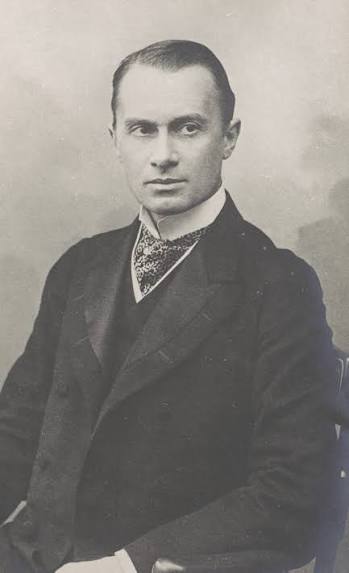 Josef Gottfried Ignaz Kainz (January 2, 1858 - September 20, 1910) was born on January 2, 1858, in Moson (now part of Mosonmagyaróvár, Hungary), which was then part of the
Austrian Empire. His father worked as a railroad official, and in 1867, the family relocated to Vienna. Showing an early passion for performance, Kainz began his acting
career at the young age of fifteen. He went on to hone his craft through early theatrical engagements in regional venues, including Maribor (Marburg an der Drau), Leipzig,
and Meiningen.
Josef Gottfried Ignaz Kainz (January 2, 1858 - September 20, 1910) was born on January 2, 1858, in Moson (now part of Mosonmagyaróvár, Hungary), which was then part of the
Austrian Empire. His father worked as a railroad official, and in 1867, the family relocated to Vienna. Showing an early passion for performance, Kainz began his acting
career at the young age of fifteen. He went on to hone his craft through early theatrical engagements in regional venues, including Maribor (Marburg an der Drau), Leipzig,
and Meiningen.
Kainz rose to widespread prominence starting in 1880 when he began working with Ernst von Possart at the National Theatre
in Munich. During this time, his striking beauty and exceptional dramatic talent captured the attention of King
Ludwig II of Bavaria. Ludwig became intensely captivated by Kainz, engaging him for exclusive private performances and
showering him with lavish gifts, such as a diamond and sapphire ring and a gold swan chain. In April 1881, after seeing him perform in Victor Hugo's Marion de Lorme, Ludwig
invited Kainz—whom the king nicknamed "Didier"—to Linderhof Palace. This association developed into a prominent chapter in the history of Ludwig's personal life; throughout
his reign, the king maintained a succession of close personal and romantic relationships with men, including figures like his chief equerry
Richard Hornig, courtier Alfons Weber, and Josef Kainz.
The peak of their public association occurred in the summer of 1881, when Ludwig II and Kainz undertook a notoriously demanding joint journey to Switzerland. The trip was
designed to trace the original settings of Friedrich Schiller's drama William Tell, during which Kainz was expected to recite passages at historic sites like the Rütlihaus.
However, the excursion ultimately ended in disillusionment and a cooling of their relationship. The actor was physically exhausted by rigorous alpine hikes and strained by
the king's intense, utopian expectations regarding text delivery. A permanent rift formed after Kainz eventually refused the king's demanding artistic requests. Before
parting ways, they visited a photo studio in Lucerne to have a souvenir portrait taken. In the resulting photograph, Kainz's hand rested on Ludwig's shoulder—a breach of
royal protocol that later led to the hand being heavily retouched out of published versions to suppress the intimacy of the image. Kainz formally left Munich in 1883 after
being refused a final audience to bid the king farewell.
Following his departure from Munich, Kainz built a legendary career on the German-speaking stage. In 1884, he joined the newly established Deutsches Theater in Berlin,
where he achieved immense acclaim playing iconic roles such as Hamlet, Richard II, Don Carlos, and Franz Moor in The Robbers. After a brief stint at the Berliner Theater
under director Ludwig Barnay ended in contractual disputes and a temporary professional ban on German stages, Kainz toured internationally before returning to Berlin in
1892. His career culminated in Vienna, where he joined the prestigious Burgtheater in 1899 and was honored with the title of Hofschauspieler (Court Actor), dazzling
audiences as Shylock in The Merchant of Venice and in Tartuffe.
Kainz was married to actress Sarah Hutzler from 1886 to 1893. Widely revered as one of the greatest actors in the history of German-language theater, Kainz died of cancer
in Vienna on September 20, 1910, just days after being appointed director of the Burgtheater. He is buried at the Döbling Cemetery in Vienna, and his theatrical legacy was
long honored by the city of Vienna through the annual presentation of the Kainz Medal for outstanding acting.
References:
Other references:
- Helene Richter, Kainz (Vienna and Leipzig: Speidel, 1931) – Widely recognized as the standard, comprehensive biographical work on Josef Kainz's life, artistry, and theatrical contributions.
- Felix Philippi, Ludwig II. und Josef Kainz: und anderes aus meinem Tagebuche (Berlin: F. Lehmann, 1913) – Contemporary memoirs and diary accounts detailing the personal and artistic interactions between King Ludwig II and Josef Kainz, including their famous 1881 Swiss excursion.
- Otto Brahm, Kainz: Gesehenes und Erlebtes (Berlin: Fleischel, 1910) – Direct observations and theatrical criticisms written by a prominent contemporary director and critic who closely followed Kainz's stage career.
- Gustav Kober, Josef Kainz: Mensch unter Masken (Vienna: Paul Neff, 1948) – A detailed mid-20th-century biography exploring Kainz's psychological depth, personal life, and public persona.
- Wolfgang Noa (ed.), Josef Kainz: Briefe (Berlin: Henschel, 1966) – A curated collection of Kainz's personal correspondence, offering primary insight into his thoughts, relationships, and professional challenges
- Sean Edgecomb, "A Performance between Wood and the World: Ludwig II of Bavaria's Queer Swans," Theatre Survey (Cambridge University Press, 2018) – An academic examination of King Ludwig II's homosocial and romantic network, analyzing his relationships with figures like Richard Hornig and Josef Kainz within the context of 19th-century royal queer history.
- Desmond Chapman-Huston, Bavarian Fantasy: The Story of Ludwig II (Schuman, 1956) – A historical study of Ludwig II's reign, private life, and inner circle, documenting his romantic attachments to male courtiers and actors.
- McIntosh, Christopher, The Swan King: Ludwig II of Bavaria (I.B. Tauris, 2012) – A comprehensive biography of Ludwig II that details his patronage of the arts, intense infatuations with actors such as Josef Kainz, and the political implications of his private life.
Support this project
This website is a passion project researched, developed, and funded entirely by me. If you find the content valuable and would like to help support the ongoing research and hosting costs, any contribution is deeply appreciated.
Thank you for keeping this independent resource alive!
My books on Amazon: Elisa Rolle's books
BACK TO HOME PAGE
