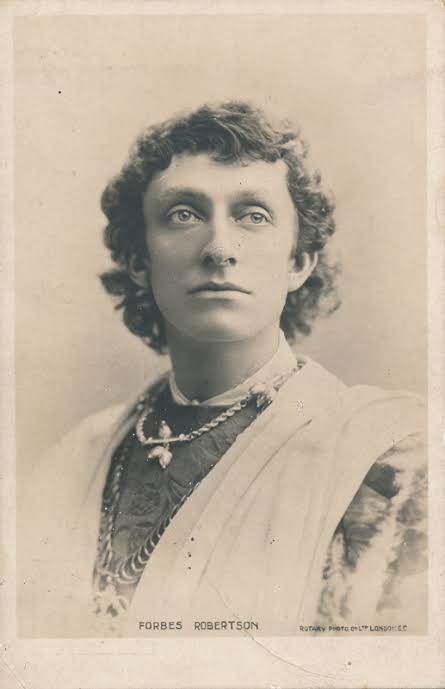
 Sir Johnston Forbes-Robertson (January 16, 1853 – November 6, 1937) was an eminent English actor and manager, celebrated primarily for his classical stage performances and
his commanding interpretations of Shakespearean roles.
Sir Johnston Forbes-Robertson (January 16, 1853 – November 6, 1937) was an eminent English actor and manager, celebrated primarily for his classical stage performances and
his commanding interpretations of Shakespearean roles.Queer Places:
22 Bedford Square, London WC1B 3HH, UK
Bay Hill House (which they later renamed Bloms), Bay Hill, St Margarets Bay, Dover CT15 6DH, United Kingdom
Golders Green Crematorium, 62 Hoop Ln, London NW11 7NL, United Kingdom
Sir Johnston Forbes-Robertson (January 16, 1853 – November 6, 1937) was an eminent English actor and manager, celebrated primarily for his classical stage performances and
his commanding interpretations of Shakespearean roles.
Born in London to the Scottish art critic and journalist John Forbes-Robertson and Frances Hannah Cotton, Johnston was the eldest of eleven children. He initially pursued a career in the visual arts, studying at the Royal Academy Schools with the ambition of becoming a painter. However, his natural theatrical presence and family connections to the arts directed him toward the stage. He made his professional acting debut in London in 1874.
Forbes-Robertson quickly rose to prominence through his refined diction, striking physical appearance, and deeply intellectual approach to character development. He worked alongside leading theatrical figures of the late 19th and early 20th centuries, including Henry Irving and the actress Mrs. Patrick Campbell, with whom he formed a legendary partnership.
His defining theatrical triumph was his portrayal of Hamlet, which he first played in 1897 at the Lyceum Theatre. Widely regarded by critics of the era as one of the definitive interpretations of the role, his Hamlet was praised for its youthful melancholy, naturalistic delivery, and profound psychological depth. He continued to perform the role into his sixties. Other notable roles included Othello, Macbeth, and Caesar in George Bernard Shaw's Caesar and Cleopatra (1907). He was knighted in 1913, marking a high point in his theatrical career, and formally retired from the stage in 1913 with a farewell tour culminating in a final London season in 1915.
As a young man exploring London's avant-garde and artistic circles, Forbes-Robertson moved among Pre-Raphaelite and aesthetic movement artists who frequently bridged conventional social boundaries.
The Pre-Raphaelite painter Simeon Solomon, who was openly part of London's underground network of homosexual and bisexual artists and writers before his public disgrace and arrest in 1873, frequently used young male actors, artists, and models as subjects for his homoerotic and allegorical drawings.
Until the Day Break and the Shadows Flee Away (1869): Forbes-Robertson, possessing the striking, classical features favored by the Pre-Raphaelites, posed as a young man for one of the central figures in Solomon's symbolic drawing. The artwork's title is drawn from the biblical Song of Solomon (4:6), a text frequently reinterpreted within queer artistic circles of the period to evoke hidden romance, nocturnal longing, and clandestine devotion.
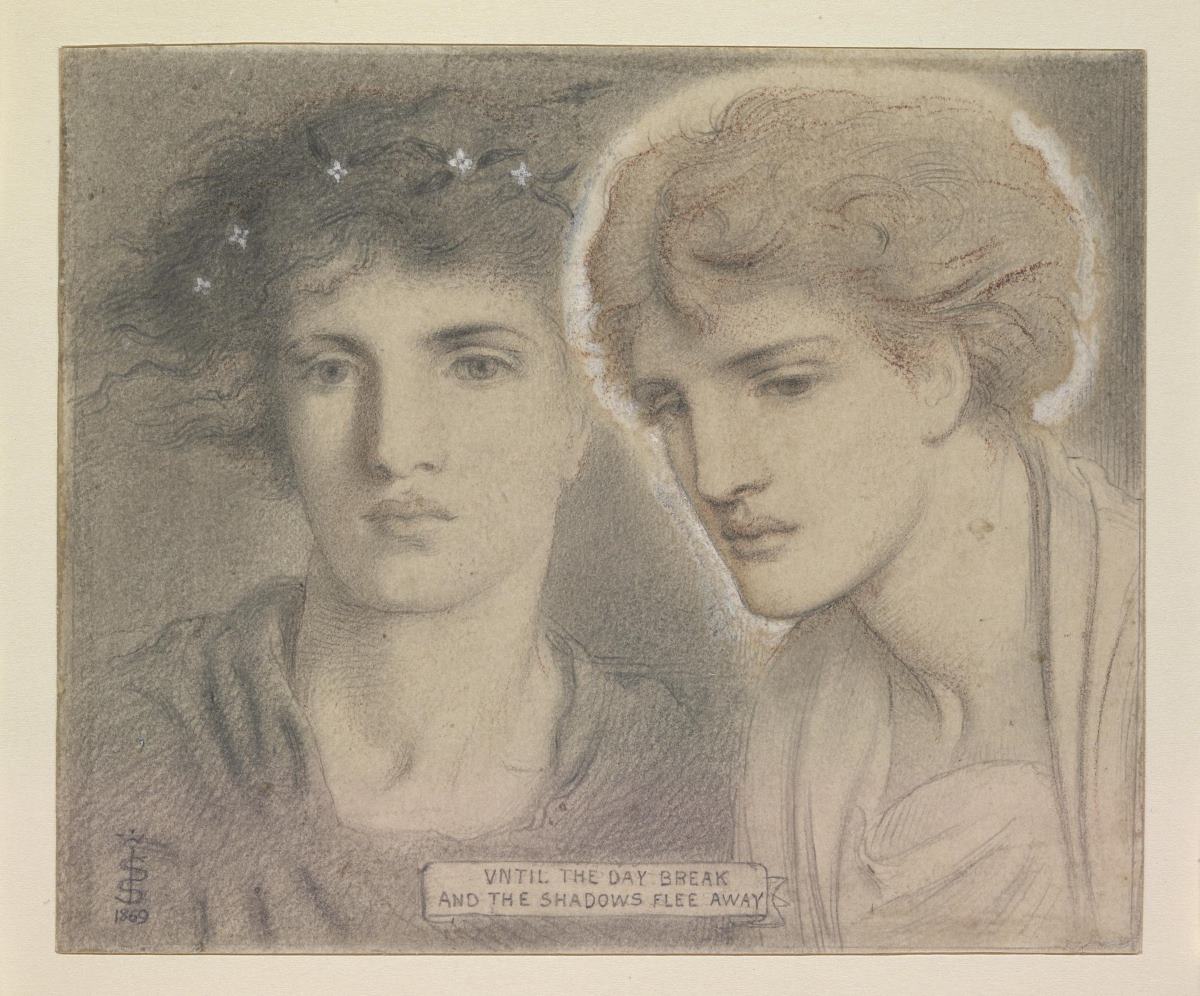
Until the day break, and the shadows flee away; Simeon Solomon - The British Museum
In 1900, at age 47, Johnston Forbes-Robertson married the American-born actress Gertrude Elliott (sister of Maxine Elliott) with whom he had four daughters. Their first daughter was Maxine Forbes-Robertson known as 'Blossom', who married the aircraft designer F. G. Miles and became a director and designer of the Miles Aircraft company. She previously married Inigo Freeman-Thomas, 2nd Marquess of Willingdon, in 1924; they divorced in 1932. Their second daughter Jean Forbes-Robertson became an actress. Through Jean he is the grandfather of actress Joanna Van Gyseghem. Their third daughter was Chloe Forbes-Robertson (1909–1947), an artist. Diana Forbes-Robertson (1914–1988), their fourth daughter, was a writer who later wrote a biography of her aunt Maxine Elliott.
In 1911 one of the major celebrities of the day, UK and USA stage and film actor George Arliss, the first British Academy Award winner, and his wife Florence, rented a cottage in the middle of the village. He was followed by friends like Johnston Forbes- Robertson, the ‘Hamlet of his day’ who had also been a big stage star in the UK and in America, who bought a country house ‘Bloms’ at the top of Bay Hill in 1918. A family friend of the Forbes- Robertson’s, Noel Coward, rented ‘White Cliffs’ and other houses on the beach in 1945. Coward entertained many of his famous friends such as actors Spencer Tracy and Katharine Hepburn, John Mills and writer Daphne du Maurier at weekend parties at the house. In 1951 Coward sublet a house to another friend, Ian Fleming, who based part of one of his famous Bond books, ‘Moonraker’ on the adjacent cliffs. Peter Ustinov bought a house here in the 1950’s after falling in love with it during his wartime service in the village. This was later bought by the award winning actress Miriam Margoyles.
References:
Other references:
Support this project
This website is a passion project researched, developed, and funded entirely by me. If you find the content valuable and would like to help support the ongoing research and hosting costs, any contribution is deeply appreciated.
Thank you for keeping this independent resource alive!
My books on Amazon: Elisa Rolle's books

