Queer Places:
Harrow School, 5 High St, Harrow HA1 3HP, United Kingdom
Euston Hall, Euston, Thetford IP24 2QW, United Kingdom
St Genevieve Churchyard, Euston, Thetford IP24 2QW, United Kingdom
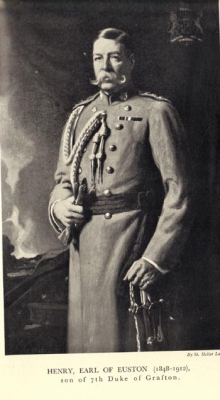 Henry James FitzRoy, Earl of Euston (November 28, 1848 – May 10, 1912), was a British aristocrat, military officer, and heir apparent to the 7th Duke of Grafton. Though he
spent much of his life involved in civic, military, and Masonic affairs, his legacy became heavily intertwined with late-Victorian LGBTQ+ history through his connection to
the Cleveland Street Scandal of 1889.
Henry James FitzRoy, Earl of Euston (November 28, 1848 – May 10, 1912), was a British aristocrat, military officer, and heir apparent to the 7th Duke of Grafton. Though he
spent much of his life involved in civic, military, and Masonic affairs, his legacy became heavily intertwined with late-Victorian LGBTQ+ history through his connection to
the Cleveland Street Scandal of 1889.
Born in London, FitzRoy was the eldest son of Augustus FitzRoy, 7th Duke of Grafton, and Anna Balfour. Anna Balfour (1825–1857) was James Balfour's daughter. In 1847, she
married Lord Augustus FitzRoy (later the 7th Duke of Grafton), making her the mother of Henry James FitzRoy, Earl of Euston. James Maitland Balfour (1820–1856) was Anna’s
elder brother. He married Lady Blanche Gascoyne-Cecil and fathered Arthur Balfour, who served as Prime Minister of the United
Kingdom from 1902 to 1905.
Henry James FitzRoy was educated at Harrow School and held commissions in the Rifle Brigade, the Coldstream Guards, and later commanded the 1st Volunteer Battalion of the
Northamptonshire Regiment.
His personal life was notoriously chaotic: In 1871, he married Kate Walsh (a music-hall performer known as "Kate Cooke"). The couple separated after three years. Lord
Euston later attempted to annul the marriage when he discovered Walsh had been previously married, leading to a trial that revealed her former husband had also committed
bigamy, validating Euston's marriage to Walsh.
Later in life, Euston accumulated severe debts through moneylenders and was declared bankrupt in 1902 with liabilities exceeding £54,000.
Lord Euston’s name is prominently featured in LGBTQ+ historical accounts due to his involvement in the Cleveland Street Scandal—a major event in late 19th-century British
queer history.
In July 1889, London police uncovered a male brothel at 19 Cleveland Street staffed by young Post Office telegraph messengers. At the time, all male homosexual acts were
illegal under Section 11 of the Criminal Law Amendment Act 1885. When police investigated, several messenger boys named prominent aristocrats as clients. To avoid a
high-society panic involving figures like Lord Arthur Somerset (equerry to the Prince of Wales), authorities quietly delayed
prosecutions, allowing key figures to flee the country.
In November 1889, Ernest Parke, the editor of the radical newspaper The North London Press, published an article naming Lord Euston as one of the elite patrons of the
brothel, claiming he had fled to Peru to escape prosecution.
Euston was still in England and immediately sued Parke for criminal libel. In court, Euston testified that he had visited 19 Cleveland Street once, but claimed he was
misled by a promotional card handed to him in Piccadilly advertising "Poses plastiques" (which he claimed he believed was a female nude performance). He maintained that upon
entering and discovering the house was a male brothel, he was appalled and left immediately.
The defense called John Saul, a well-known male prostitute, who testified under oath that Euston had been a frequent visitor and client at the brothel. However, the jury
found the defense witnesses unreliable and ruled in favor of Euston. Parke was sentenced to 12 months in prison for libel.
Historians and queer scholars remain divided on whether Lord Euston was genuinely innocent or shielded by upper-class privilege:
Historians like H. Montgomery Hyde argued that Euston likely spoke the truth and was simply tricked into visiting the
establishment once by a deceptive flyer.
Other accounts suggest Euston was a known figure in London’s underground homosexual scene. Contemporaries like Robert Cliburn—a notorious blackmailer targeting wealthy
gay men—claimed Euston was one of his regular victims. The author Oscar Wilde famously joked that Cliburn deserved the Victoria Cross
for his tenacity in extracting money from Euston.
In his later years, Euston served as an aide-de-camp to King Edward VII (1901) and as Deputy Lieutenant for Northamptonshire (1907).
The Church of St Genevieve and its accompanying churchyard, located on the grounds of the Euston Hall estate near Thetford (postcode IP24 2QW), serve as the historic
ancestral burial site for the FitzRoy family, the Dukes of Grafton. Following his death from edema (dropsy) at Wakefield Lodge on 10 May 1912 at age 63, Lord Euston's
remains were brought back to the family seat in Suffolk. He was laid to rest in the churchyard of St Genevieve, joining generations of his FitzRoy ancestors. St Genevieve
Church sits inside Euston Park, adjacent to Euston Hall, which has been the country seat of the Dukes of Grafton since the late 17th century. Originally a medieval church,
St Genevieve was famously rebuilt in 1676 by Henry FitzRoy, 1st Duke of Grafton (an illegitimate son of King Charles II and Barbara Palmer). It is unique as the only church
in Suffolk built entirely in the 17th century, featuring fine Restoration-era woodwork and classic Italianate architecture. As the eldest son and heir apparent of Augustus
FitzRoy, 7th Duke of Grafton, Lord Euston was raised in close association with the Euston estate. The interior of St Genevieve and the surrounding churchyard house numerous
monuments, brasses, and headstones dedicated to the Earls of Euston and Dukes of Grafton—including his grandfather, his parents, and later family members who held the title
after his death.
References:
- https://grokipedia.com/page/Henry_James_FitzRoy,_Earl_of_Euston
- https://en.wikipedia.org/wiki/Henry_James_FitzRoy,_Earl_of_Euston
- https://ianwaugh.com/2025/01/01/the-west-end-scandals-courtroom-intrigue-conspiracy-and-the-cleveland-street-saga-1890/
- https://lgbthistoryuk.org/wiki/Cleveland_Street_scandal
- https://rictornorton.co.uk/eighteen/1889clev.htm
- https://kids.kiddle.co/Henry_James_FitzRoy,_Earl_of_Euston
Support this project
This website is a passion project researched, developed, and funded entirely by me. If you find the content valuable and would like to help support the ongoing research and hosting costs, any contribution is deeply appreciated.
Thank you for keeping this independent resource alive!
My books on Amazon: Elisa Rolle's books
BACK TO HOME PAGE