Queer Places:
Cooper Union, 30 Cooper Sq, New York, NY 10003, United States
The Art Students League, 215 W 57th St, New York, NY 10019
103 E 15th St, New York, NY 10003, USA
Bordentown Cemetery, 210 Crosswicks Rd, Fieldsboro, NJ 08505, United States
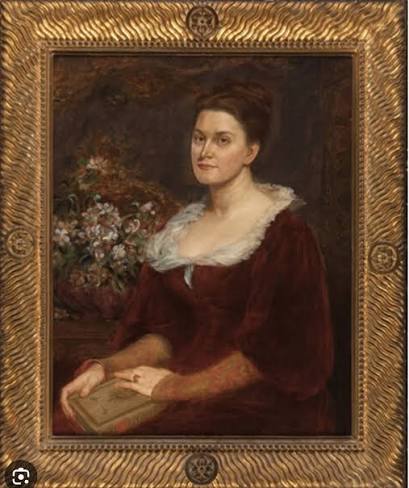 Helena de Kay Gilder (January 14, 1846 - May 28, 1916) was an American painter, illustrator, and central figure of the late nineteenth-century New York art world. While
history often remembers her as a cultural hostess, she was a pioneering advocate for women's art education and co-founded some of the era's most significant independent
art organizations.
Helena de Kay Gilder (January 14, 1846 - May 28, 1916) was an American painter, illustrator, and central figure of the late nineteenth-century New York art world. While
history often remembers her as a cultural hostess, she was a pioneering advocate for women's art education and co-founded some of the era's most significant independent
art organizations.
Helena was born in New Jersey to a prominent family. Her father, George Coleman de Kay, was a naval officer who died when she was only two years old. Following his
death, her mother relocated the family to Dresden, Germany—a cultural and artistic hub—where Helena spent her childhood learning multiple languages and cultivating an
early love for the arts.
In 1861, the family returned to the United States and settled in Newport, Rhode Island. In Newport, Helena studied privately under the celebrated artist John La Farge
and became lifelong friends with the writer Henry James. She later moved to New York City to enroll in the newly formed Free
School of Art for Women at Cooper Union (1866–1869), followed by further studies at the National Academy of Design.
While studying at Cooper Union, Helena met Mary "Molly" Hallock (later Mary Hallock Foote), who would become a famous
illustrator and novelist of the American West. The passionate, romantic language of their extensive correspondence—including the letters you cited—reflects what
historians describe as a "romantic friendship" or "Boston marriage" dynamic, which was common among educated, independent 19th-century women. These relationships
featured deep emotional, physical, and romantic intensity, often walking the line between what modern audiences recognize as queer love and deep platonic devotion.
Though both eventually married men, their emotional and professional bond lasted their entire lives. They read, reviewed, and critiqued each other’s work, and Molly’s
late-life novel, Edith Bonham (1917), was heavily inspired by Helena.
Helena de Kay’s career was defined by her determination to build spaces for artists outside of traditional, conservative institutions:
Frustrated by the conservative teaching styles and limited access to life-drawing classes for women at the National Academy of Design, Helena and a group of fellow
students founded The Art Students League (1875). It became one of the country's most influential, democratic art schools.
Helena was also a co-founder of The Society of American Artists (1877), which rebelled against the academic rigidity of the National Academy and gave younger,
European-trained American artists a platform to display progressive work.
Before her marriage, Helena was a private student and muse to the legendary painter Winslow Homer. Homer was reportedly deeply in love with her, and she is the subject
of several of his famous works, including Shall I Tell Your Fortune? (1875).
In 1874, Helena married the poet and editor Richard Watson Gilder. Gilder was the powerful editor of Scribner’s Monthly (later The Century Magazine), the most
prestigious literary periodical of the era.
Together, the Gilders became the ultimate cultural tastemakers of New York’s Gilded Age. From their home at 103 E 15th St, New York, NY 10003, they hosted famous
Friday night salons that brought together the finest minds of the era, including Walt Whitman,
Mark Twain, Augustus Saint-Gaudens, and Helena’s close friend, Molly Hallock Foote (whose illustration career was heavily promoted
by the Gilders).
Decades later, author Wallace Stegner used the extensive letters and lives of Mary Hallock Foote and Helena de Kay Gilder as the direct basis for his Pulitzer
Prize-winning novel, Angle of Repose (1971).
Helena gave birth to seven children, five of whom survived to adulthood. By the late 1880s, she stepped back from exhibiting her own paintings to focus on her family,
her salons, and her writing. Surprisingly, despite her early progressive work for women's education, she became an active member of the anti-suffrage movement later in
life, believing that a political role would compromise women’s moral and cultural influence.
Helena de Kay Gilder died on May 28, 1916, following a sudden surgery for appendicitis, leaving behind a profound legacy as an architect of the American art world.
References:
Other references:
- https://www.invaluable.com/artist/gilder-helena-dekay-np708s9ayq/
- https://historicwomensouthcoast.org/helena-de-kay-gilder/
- https://www.illustrationhistory.org/artists/mary-hallock-foote
- https://emuseum.delart.org/people/10652/helena-de-kay-gilder
- https://digital.janeaddams.ramapo.edu/items/show/5186
- https://americanaristocracy.com/people/helena-de-kay-gilder
Support this project
This website is a passion project researched, developed, and funded entirely by me. If you find the content valuable and would like to help support the ongoing research and hosting costs, any contribution is deeply appreciated.
Thank you for keeping this independent resource alive!
My books on Amazon: Elisa Rolle's books
BACK TO HOME PAGE
