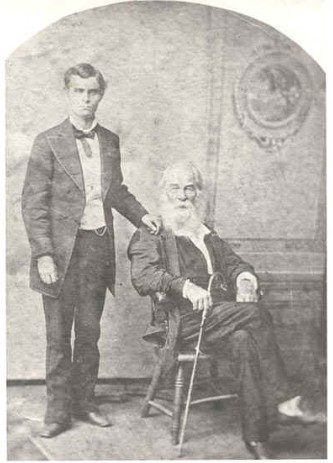
 Henry Lamb Stafford (March 25, 1858 - December 9, 1918), born on March 25, 1858, in Washington Township, New Jersey, was a significant figure in the later life of the
American poet Walt Whitman. The son of George Stafford and Susanna M. Lamb, Harry grew up in the Camden, New Jersey area. His early
life was relatively conventional, yet he is historically remembered primarily for the intense and complex relationship he developed with Whitman starting in 1876. At the
time they met, Stafford was an eighteen-year-old clerk working at the Camden New Republic, where the fifty-seven-year-old Whitman frequently visited to work on the
Centennial edition of his masterwork, Leaves of Grass.
Henry Lamb Stafford (March 25, 1858 - December 9, 1918), born on March 25, 1858, in Washington Township, New Jersey, was a significant figure in the later life of the
American poet Walt Whitman. The son of George Stafford and Susanna M. Lamb, Harry grew up in the Camden, New Jersey area. His early
life was relatively conventional, yet he is historically remembered primarily for the intense and complex relationship he developed with Whitman starting in 1876. At the
time they met, Stafford was an eighteen-year-old clerk working at the Camden New Republic, where the fifty-seven-year-old Whitman frequently visited to work on the
Centennial edition of his masterwork, Leaves of Grass.
The relationship between the young, moody, and impulsive Stafford and the aging poet evolved into one of the most significant and intimate personal connections of
Whitman’s later years. Whitman often visited the Stafford family home at White Horse Farm near Kirkwood, New Jersey, where he found a refuge that aided his recovery from the
stroke he had suffered in 1873. The Stafford family, who admired Whitman as a mentor to their son, welcomed the poet into their lives, even displaying his portrait in their
home. During this period, Whitman and Stafford frequently spent time together, including sleeping in the same bedroom and traveling in one another’s company. Whitman often
referred to Stafford as his "nephew" or his "darling boy" in correspondence, and he notably bequeathed his silver watch to Stafford in his will.
In the context of LGBTQ history, the bond between Whitman and Stafford is widely analyzed by scholars as having a clear romantic and erotic charge. Their relationship was
characterized as both intense and volatile, marked by frequent arguments and emotional reconciliations. Records indicate that they occasionally exchanged tokens of
affection, such as a friendship ring that Stafford reportedly returned to the poet during periods of disagreement. Stafford’s own letters to Whitman, as well as the poet’s
surviving correspondence to him, offer insights into a relationship that defied the social norms of the era. Scholars often categorize this dynamic as an expression of the
"Calamus" theme in Whitman’s work, which celebrated passionate, egalitarian, and often physical bonds between men. While some earlier biographers attempted to characterize
the relationship in strictly platonic or mentorship terms, modern critics and historians generally recognize the connection as a deeply personal and likely same-sex intimacy
that was central to Whitman’s later life and emotional well-being.
Following his period of closest association with Whitman, Harry Stafford’s life shifted toward more traditional social structures. He married Eva M. Westcott in 1883, and
the couple went on to have several children. Despite this change in his life, he remained in contact with Whitman for years afterward, and the poet continued to correspond
with both Harry and his wife. Stafford lived in various parts of New Jersey, including Cape May and Upper Township, throughout his adult life. He eventually passed away on
December 9, 1918, at the age of sixty, and was interred in Haddonfield, New Jersey. His legacy remains inextricably linked to his role as one of the "working-class boys" who
played a profound, often misunderstood, and historically pivotal role in the life and creative inspiration of Walt Whitman.
References:
- The Walt Whitman Archive: This is the most comprehensive digital resource for the correspondence between Whitman and Stafford. It includes transcriptions of letters, editorial notes, and the encyclopedic entry "Stafford, Harry Lamb [1858-1918]" by Arnie Kantrowitz.
- Whitman, Walt. The Correspondence. Edited by Edwin Haviland Miller. 6 vols. New York: New York University Press, 1961–1977. This multi-volume work contains the primary letters exchanged between the two men.
- "Three Unpublished Whitman Letters to Harry Stafford and a Specimen Days Prose Fragment," Walt Whitman Quarterly Review: This article provides additional documentation on the relationship and contextual notes regarding the Stafford family farm.
- Allen, Gay Wilson. The Solitary Singer: A Critical Biography of Walt Whitman. Revised ed. Chicago: University of Chicago Press, 1985. A foundational biography that explores Whitman’s life and personal associations.
- Callow, Philip. From Noon to Starry Night: A Life of Walt Whitman. Chicago: Ivan R. Dee, 1992. A biographical work providing context for Whitman's later years in Camden.
- Folsom, Ed. "An Unknown Photograph of Whitman and Harry Stafford." Walt Whitman Quarterly Review 3 (Spring 1986). An academic analysis of photographic evidence documenting their association.
- Kaplan, Justin. Walt Whitman: A Life. New York: Simon and Schuster, 1980. A detailed biographical study of the poet.
- Katz, Jonathan Ned. "Sexuality." In Walt Whitman in Context. Cambridge University Press. This text discusses the sociocultural context of 19th-century male intimacies, specifically referencing the relationship between Whitman and Stafford.
- Shively, Charley. Calamus Lovers: Walt Whitman's Working Class Camerados. San Francisco: Gay Sunshine, 1987. A critical work focusing on the nature of Whitman’s relationships with the younger, working-class men in his life.
- FamilySearch: The "Henry Lamb Stafford (1858–1918)" entry in the Ancestors database provides access to census records, marriage records (specifically his 1883 marriage to Eva M. Westcott), and burial information.
Support this project
This website is a passion project researched, developed, and funded entirely by me. If you find the content valuable and would like to help support the ongoing research and hosting costs, any contribution is deeply appreciated.
Thank you for keeping this independent resource alive!
My books on Amazon: Elisa Rolle's books
BACK TO HOME PAGE