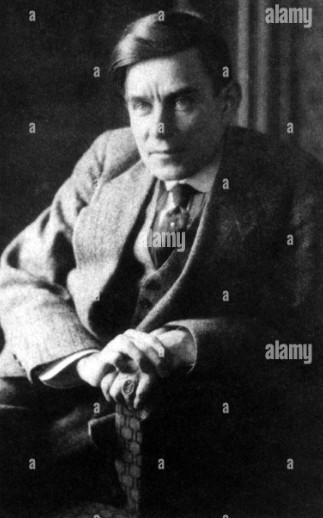
 Gilbert Clavel (May 29, 1883 – September 6, 1927) was an influential Swiss archaeologist, writer, visionary architect, and avant-garde art collector.
Queer Places:
Clavelgut, Bonergasse 75, 4057 Basel
Villa Saida, Seconda Traversa Timpone, 2, 80071 Anacapri NA
Torre di Clavel, Via Fornillo, 84017 Positano SA
Wolfgottesacker, Münchensteinerstrasse 99, 4052 Basel, Switzerland
Gilbert Clavel (May 29, 1883 – September 6, 1927) was an influential Swiss archaeologist, writer, visionary architect, and avant-garde art collector.
Born into a wealthy, prominent family in Basel, Switzerland, to industrialist Alexandre Clavel-Merian and Emilie Merian, Clavel grew up with substantial financial independence derived from his family's successful textile and chemical concerns. From an early age, his life was shaped by profound physical suffering. Born with severe spinal deformity—which earned him the local Neapolitan nickname 'O Scartelluzzo ("the little hunchback")—he also suffered from advanced tuberculosis, a condition that permanently damaged his health, gave him a distinct rasping voice, and drove him toward warmer climates. Despite these physical limitations, he was widely recognized for his razor-sharp intellect, extensive education, and eccentric, high-energy persona. He completed his university studies in archaeology in 1907, a discipline that deeply informed his later aesthetic and philosophical theories.
Driven by medical advice to seek a maritime climate for his lung ailment, Clavel moved to Italy in 1910 alongside his father. They settled on the island of Capri, where they purchased the Villa Saida in Anacapri. Capri at the time served as an enclave for bohemian artists, expatriates, and queer intellectuals who sought refuge from mainland social norms. On the island, Clavel integrated himself into the notorious aristocratic and literary circles of the period, forming a close relationship with the French poet Baron Jacques d'Adelswärd-Fersen. Clavel shared Fersen’s aesthetic sensibilities, decadent lifestyle, interest in narcotics, and non-conforming sexual outlook. Through these social networks, Clavel navigated the open homosexual and bisexual subculture of Capri, maintaining close ties with figures like the writer Norman Douglas, who noted Clavel’s abrasive manners, deep intellect, passion for natural history, and business acumen. While residing in Anacapri, Clavel operated a local wine business and managed import-export operations in Naples, accumulating substantial wealth by supplying resources to various European markets during the First World War.
Clavel’s interest in spatial design and symbolism reached its peak in Positano. In 1909, he bought the ruined 16th-century coastal watchtower known as the Torre di Fornillo for 150 lire. Over the next decade, Clavel completely transformed the site into an avant-garde architectural complex later known as Castel Clavel. Acting as a self-taught architect, Clavel excavated the cliff face surrounding the tower, blasting and drilling through solid rock to construct subterranean corridors, rooms, and underground grottos. Drawing on the mythological theories of Johann Jakob Bachofen, Clavel described his creation as an "architecture of the chthonic"—an attempt to weave together living spaces, natural stone, and ancient mortuary symbolism into a dynamic subterranean labyrinth. Theorists such as Siegfried Kracauer later remarked on this singular creation, framing it as a physical manifestation of Clavel's desire to construct an enduring, eternal body made of stone to replace his own ailing, fragile anatomy.
During the late 1910s, Clavel became heavily involved with the Italian Futurist movement, forging a renowned creative partnership with the artist Fortunato Depero. Together, they developed groundbreaking experimental theater productions. In 1918, they premiered Balli Plastici at the Teatro dei Piccoli in Rome, an avant-garde performance in which human dancers were replaced by stylized geometric wooden marionettes moving to compositions by Alfredo Casella, Gerald Tyrwhitt, Gian Francesco Malipiero, and Béla Bartók. Beyond his theatrical work, Clavel authored literary pieces including the narrative Un istituto per suicidi (An Institute for Suicides), illustrated by Depero, and the essay Espressioni d’Egitto (Expressions of Egypt), inspired by his extensive travels through Aswan with his father in 1911.
As his health deteriorated drastically due to his long-standing illness, Clavel left Italy in 1927 and returned to his hometown of Basel. Severely suffering from physical decay, he died by suicide on September 6, 1927, at the age of 44. He was laid to rest in the Wolfgottesacker cemetery in Basel. Today, Clavel remains remembered as a pioneer of puppet theater, an early contributor to Futurist architecture, and a central, enigmatic figure within early 20th-century queer European expatriate history.
References:
 Capri: Island of Pleasure Hardcover – January 1, 1987 by James Money |
Other references:
Support this project
This website is a passion project researched, developed, and funded entirely by me. If you find the content valuable and would like to help support the ongoing research and hosting costs, any contribution is deeply appreciated.
Thank you for keeping this independent resource alive!
My books on Amazon: Elisa Rolle's books