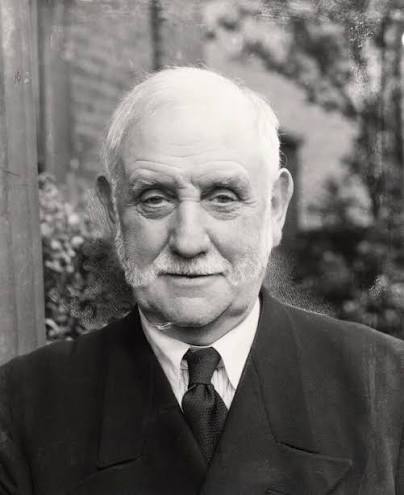
 George Lansbury (February 22, 1859 – May 7, 1940), born on February 22, 1859, in Lowestoft, Suffolk, was a prominent British politician, social reformer, and pacifist whose
lifelong commitment to the working class, women's suffrage, and social justice left a profound mark on modern British political history. Rising from humble origins, he
became a leading figure in the Labour Party, serving as its leader from 1931 to 1935, and championed radical causes ranging from anti-imperialism and nuclear disarmament to
municipal socialism and gender equality. His legacy remains deeply intertwined with the broader progressive movements of the late nineteenth and early twentieth centuries,
reflecting a rare consistency of moral conviction across decades of public life.
George Lansbury (February 22, 1859 – May 7, 1940), born on February 22, 1859, in Lowestoft, Suffolk, was a prominent British politician, social reformer, and pacifist whose
lifelong commitment to the working class, women's suffrage, and social justice left a profound mark on modern British political history. Rising from humble origins, he
became a leading figure in the Labour Party, serving as its leader from 1931 to 1935, and championed radical causes ranging from anti-imperialism and nuclear disarmament to
municipal socialism and gender equality. His legacy remains deeply intertwined with the broader progressive movements of the late nineteenth and early twentieth centuries,
reflecting a rare consistency of moral conviction across decades of public life.
Lansbury's political awakening was deeply rooted in the struggles of the urban poor. After immigrating briefly to Australia with his wife, Elizabeth Jane Brine, whom he
married in 1876, he returned to London and settled in the East End borough of Poplar. There, witnessing firsthand the destitution of the working classes, he immersed himself
in local radical politics. He initially joined the Liberal Party but soon grew disillusioned with its moderate stance on social reform. Aligning himself with the Social
Democratic Federation in 1892, Lansbury emerged as a fiery orator and organizer. He later became a founding member of the Independent Labour Party and played a crucial role
in the establishment of the national Labour Party in 1900. Throughout his career, he edited the influential socialist weekly The Daily Herald, using the platform to voice
uncompromising support for the underprivileged and to challenge the political establishment.
As a staunch and vocal ally of the women's suffrage movement, Lansbury broke ranks with many of his political contemporaries who shied away from the militant tactics
employed by organizations like the Women's Social and Political Union. He maintained close personal and political friendships with leading suffragettes, including
Sylvia Pankhurst, and courageously used his platform to defend women fighting for the vote. His commitment to gender equality
came at a personal cost; in 1913, he resigned his parliamentary seat representing Bow and Bromley to force a by-election centered entirely on the issue of votes for women,
an electoral gamble he ultimately lost. His unwavering solidarity earned him the deep respect of the suffrage movement, cementing his reputation as a man willing to
sacrifice his own political career for the principle of universal enfranchisement.
Lansbury's dedication to social justice also manifested in his radical approach to local government. In 1919, he was elected mayor of the Metropolitan Borough of Poplar.
Alongside a dedicated group of councillors, he spearheaded the famous Poplar Rates Rebellion of 1921. In direct defiance of central government policy, the council refused to
levy unequal poor rates that placed an unfair financial burden on impoverished East End boroughs compared to wealthier districts. The protest resulted in Lansbury and thirty
other councillors being imprisoned for contempt of court. The high-profile imprisonment galvanized national working-class support, ultimately forcing Parliament to pass the
Local Authorities (Financial Provisions) Act 1921, which equalized rates across London. This landmark victory cemented Poplarism as a symbol of municipal resistance and
working-class solidarity.
Following the collapse of the Labour government in 1931 and the defection of Ramsay MacDonald, Lansbury assumed the leadership of a severely depleted Parliamentary Labour
Party, steering the party through one of its most turbulent eras. A devout Christian socialist, his politics were intrinsically tied to his pacifism, which became
increasingly pronounced as the threat of fascism rose in Europe during the 1930s. He famously traveled to meet Adolf Hitler and Benito Mussolini in 1935 in a futile,
idealistic attempt to avert global conflict through direct dialogue. This pacifist stance brought him into sharp ideological conflict with his own party members who
recognized the inevitability of war, leading to his resignation as Labour leader in October 1935. He spent his final years tirelessly promoting international peace and
reconciliation through organizations like the Peace Pledge Union before his death on May 7, 1940.
The intersection of George Lansbury's legacy with LGBTQ history and broader progressive commemoration is prominently recognized in contemporary London. His name,
likeness, and contributions—alongside those of 58 other historical women and men who supported women's suffrage—are permanently etched onto the bronze plinth of the statue
of Dame Millicent Fawcett in Parliament Square, unveiled in 2018 as the first monument of a woman in that historic
space. While Lansbury's own public life was defined by his traditional marriage and family, his inclusion on the monument underscores his vital role as a male suffrage
pioneer. Furthermore, his longstanding political alliance and close personal friendship with radical figures like Sylvia Pankhurst, who challenged traditional Victorian
norms surrounding gender, sexuality, and domesticity, align his historical footprint with the broader coalition of early twentieth-century reformers who dismantled rigid
social codes and laid the groundwork for modern social and sexual emancipation.
References:
- [George Lansbury Digital Archive at the LSE Library](https://staffblogs.le.ac.uk/socscilibrarians/2024/05/10/george-lansbury-digital-archive/): Maintained by the London School of Economics and Political Science (LSE) Library, containing over 30 volumes of personal and political correspondence, photographs, caricatures, press reviews, pamphlets, and election addresses covering the 1870s to the 1950s.
- [Tower Hamlets Local History Library and Archives](https://www.thcatalogue.org.uk/calmview/GetMultimedia.ashx?db=Catalog&type=default&fname=84%5C3feaec-f3c9-4c68-a2b8-98dd012213e3.pdf): Holds local government papers, photographs regarding the Poplar Rates Dispute, correspondence with Bow Vestry, and local ephemera relating to his work in East London.
- Labour History Archive and Study Centre: Located at the People's History Museum in Manchester, holding supplementary organizational records and party papers.
- [The Life of George Lansbury](https://socialhistoryportal.org/news/articles/110005) by Raymond Postgate (London: Longmans, Green & Co., 1951): The seminal, full-length historical biography written by Lansbury's son-in-law, utilizing firsthand family access and early archives.
- George Lansbury: At the Heart of Old Labour by John Shepherd (Oxford University Press, 2002): A comprehensive, modern scholarly re-evaluation tracking his Christian socialism, suffrage alliance, and political leadership.
- The Tower Hamlets Connection: A Biographical Guide by Harold Finch (1996): Documents his extensive municipal and community footprint in East London.
- My Life (London: Constable & Co., 1928): Lansbury's autobiographical account of his early years, trade unionism, and entry into Parliament.
- The Miracle of Fleet Street: The Story of the Daily Herald (London: Labour Publishing Company, 1925): A history of his tenure editing the influential socialist daily newspaper.
- What I Saw in Russia (London: L. Parsons, 1920): His firsthand account and travelogue following his 1920 visit to Soviet Russia.
- Your Part in Poverty (London: George Allen & Unwin, 1918): A detailed critique of wealth distribution and social inequality in Britain.
- Why Pacifists Should Be Socialists (London: FACT, 1937): An outline of his Christian-socialist and anti-war philosophy during the interwar period.
Support this project
This website is a passion project researched, developed, and funded entirely by me. If you find the content valuable and would like to help support the ongoing research and hosting costs, any contribution is deeply appreciated.
Thank you for keeping this independent resource alive!
My books on Amazon: Elisa Rolle's books
BACK TO HOME PAGE