Queer Places:
Villa Silberblick (the Nietzsche-Archiv), Humboldtstraße 36, 99425 Weimar, Germany
Röcken Churchyard, Röcken, 06686 Lützen
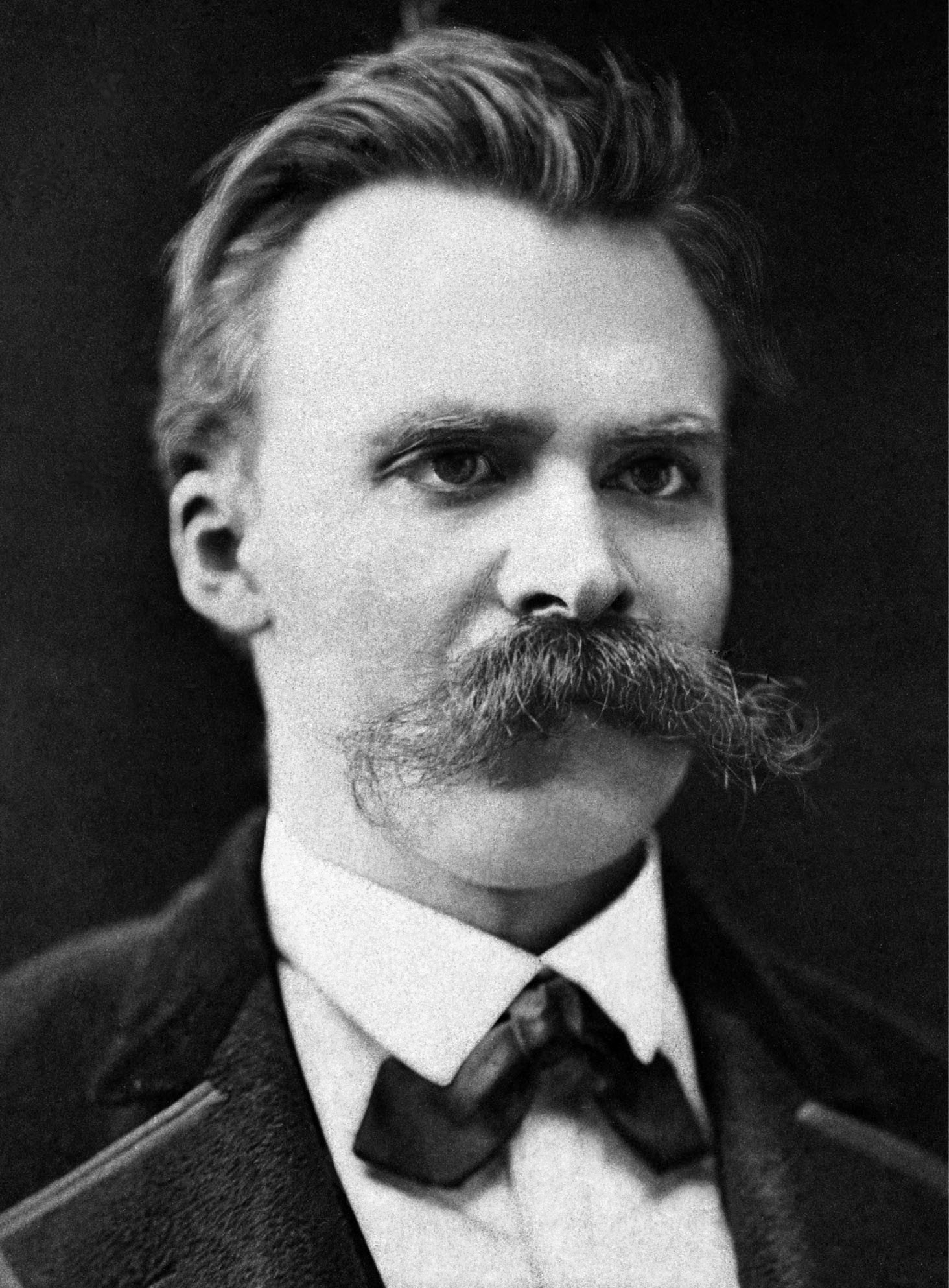 Friedrich
Wilhelm Nietzsche (15 October 1844 – 25 August 1900) was a German philosopher,
cultural critic, composer, poet, philologist, and Latin and Greek scholar
whose work has exerted a profound influence on modern intellectual history.
He began his career as a classical philologist before turning to philosophy.
He became the youngest ever to hold the Chair of Classical Philology at the
University of Basel in 1869 at the age of 24.
Nietzsche resigned in 1879 due to health problems that plagued him most of his
life; he completed much of his core writing in the following decade.
Friedrich
Wilhelm Nietzsche (15 October 1844 – 25 August 1900) was a German philosopher,
cultural critic, composer, poet, philologist, and Latin and Greek scholar
whose work has exerted a profound influence on modern intellectual history.
He began his career as a classical philologist before turning to philosophy.
He became the youngest ever to hold the Chair of Classical Philology at the
University of Basel in 1869 at the age of 24.
Nietzsche resigned in 1879 due to health problems that plagued him most of his
life; he completed much of his core writing in the following decade.
Barbara Margaretha "Meta" von Salis-Marschlins was a pioneering Swiss historian, feminist, and suffragette. She was
the first Swiss woman to earn a PhD (from the University of Zurich in 1887) and spent her life advocating for women's civic and social rights. She was also a devoted admirer
and regular correspondent of Friedrich Nietzsche.
In 1889 at age 44, he suffered a collapse and afterward a complete loss of his
mental faculties. In 1897, Meta von Salis provided the financial backing to purchase the Villa Silberblick in Weimar. This house served as both the final home for the
incapacitated Friedrich Nietzsche and his sister Elisabeth and the permanent headquarters of the Nietzsche-Archiv. Shortly after moving into Villa Silberblick, Elisabeth
took unauthorized liberties with home renovations and sent the bill directly to Meta. Outraged by Elisabeth's arrogance, financial exploitation, and overbearing behavior,
Meta abruptly cut off all personal contact with her, writing scathing letters detailing Elisabeth's toxic character. Meta thereafter refused to deal with Elisabeth directly,
forcing all subsequent property transfers to go through legal intermediaries. Nietzsche died in 1900.
Nietzsche scholar Joachim Köhler has attempted to explain Nietzsche's life
history and philosophy by claiming that Nietzsche was homosexual. Köhler
argues that Nietzsche's syphilis, which is "... usually
considered to be the product of his encounter with a prostitute in a brothel
in Cologne or Leipzig, is equally likely, it is now held, to have been
contracted in a male brothel in Genoa."
The acquisition of the infection from a homosexual brothel was confirmed by
Sigmund Freud, who cited Otto Binswanger as his source.
Köhler also suggests Nietzsche may have had a romantic relationship as well as
a friendship with Paul Rée.
There is the claim that Nietzsche's homosexuality is widely known in the
Vienna Psychoanalytic Society, with Nietzsche's friend Paul Deussen claiming
that the philosopher never "touched a woman".
Köhler's views have not found wide acceptance among Nietzsche scholars and
commentators. Allan Megill argues that, while Köhler's claim that Nietzsche
was in a confrontation with his homosexual desire cannot simply be dismissed,
"the evidence is very weak," and Köhler may be projecting twentieth-century
understandings of sexuality on nineteenth-century notions of friendship.
It is also known that Nietzsche frequented heterosexual brothels.
Some like Nigel Rodgers and Mel Thompson have argued that continuous sickness
and headaches hindered Nietzsche from engaging much with women. Yet, they
bring other examples in which Nietzsche expressed his affections to other
women, including Wagner's wife Cosima Wagner.
https://en.wikipedia.org/wiki/Friedrich_Nietzsche
Support this project
This website is a passion project researched, developed, and funded entirely by me. If you find the content valuable and would like to help support the ongoing research and hosting costs, any contribution is deeply appreciated.
Thank you for keeping this independent resource alive!
My books on Amazon: Elisa Rolle's books
BACK TO HOME PAGE