Partner Elizabeth Robins
Queer Places:
Rounton Grange estate, Northallerton, DL6 2LA, United Kingdom
St. Lawrence Churchyard, East Rounton, Northallerton DL6 2LN, United Kingdom
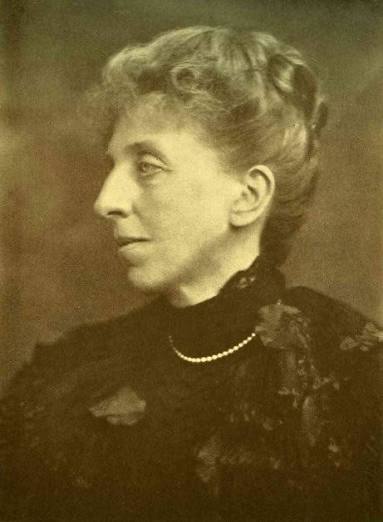 Dame Florence Bell (née Olliffe; September 9, 1851 – May 16, 1930) was a Victorian and Edwardian playwright, author, and social researcher. Though best known historically
as the stepmother of the famous explorer, diplomat, and archaeologist Gertrude Bell, she was a formidable cultural figure in her
own right.
Dame Florence Bell (née Olliffe; September 9, 1851 – May 16, 1930) was a Victorian and Edwardian playwright, author, and social researcher. Though best known historically
as the stepmother of the famous explorer, diplomat, and archaeologist Gertrude Bell, she was a formidable cultural figure in her
own right.
Born Florence Eveleen Eleanore Olliffe in Paris in September 1851, she was raised in a wealthy British family; her father was the physician to the British Embassy in
Paris. Privately educated in France, she moved to London after the Franco-Prussian War in 1870.
In 1876, Florence married Sir Thomas Hugh Bell, a wealthy ironmaster and industrialist based in Middlesbrough, North Yorkshire. Through this marriage, she became
stepmother to Hugh's two young children, Maurice and Gertrude Bell. Florence and Hugh subsequently had three children together: Hugo, Elsa, and Molly.
Florence Bell was a prolific writer, publishing over 40 works, including plays, novels, children's books, and essays.
She wrote numerous plays—some performed in London’s West End—and collaborated with American-born actress/playwright
Elizabeth Robins. Under the pseudonym "H.O. Lessing," Bell and Robins co-wrote the controversial 1893 realist play Alan's
Wife.
Bell and Robins published Alan’s wife anonymously, Robins not wanting to confuse her acting and writing reputations, and Bell mindful that her husband would rather she
didn’t engage in such exploits. It took them 30 years to acknowledge their authorship. They revelled in the intimacy of their long professional and personal association, much
of which was kept from the public eye: ‘I love you all the hours of the day’ confessed Robins to Bell, who admitted to ‘a wild longing’ for Robins. They wrote letters to each
other several times a week for the best part of 40 years.
Bell's most famous accomplishment is a landmark social study investigating the living and working conditions of ironworkers and their families in Middlesbrough, At the
Works (1907). Based on extensive interviews, At the Works exposed harsh industrial conditions and offered early insights into public health and safety.
She established the Guild of Help in Middlesbrough and pioneered the local "Winter Garden"—a alcohol-free recreational center for working-class families. For her public
contributions, she was appointed Dame Commander of the Order of the British Empire (DBE) in 1918.
Despite her social welfare work, Bell held conservative personal political views: she was a staunch anti-suffragist who publicly argued against granting women the right
to vote. She died in Knightsbridge, London, on May 16, 1930.
Florence Bell was a heterosexual woman married to Sir Hugh Bell throughout her adult life, and she is not documented as having had same-sex romantic relationships.
However, her life and literary career intersect with late-Victorian and Edwardian queer history and feminist literary networks:
Florence Bell formed a close literary and creative friendship with Elizabeth Robins, an influential actress, playwright, and suffragette. Scholars who study
late-19th-century female artistic alliances often examine Bell and Robins' intense working partnership—which the two women referred to as a "sisterhood"—within the broader
history of female romantic friendships and non-normative artistic bonds.
Through her theatrical work, Bell operated in the avant-garde London theater world of the 1890s. She collaborated with figures in J.T. Grein's Independent Theatre
Society and worked alongside prominent figures of the "New Woman" movement. These artistic networks were central hubs for gender-nonconforming, unmarried, and queer women
of the Edwardian era who sought creative independence outside traditional Victorian household structures.
In archival letters between Florence Bell and her stepdaughter Gertrude Bell, the word "queer" appears occasionally (e.g., Gertrude writing to Florence describing
foreign affairs as "A queer world, as I said to you before"). In the late 19th and early 20th centuries, this reflected the word's original definition meaning "strange,
peculiar, or unusual," rather than its modern orientation/identity framing.
References:
Other references:
- Bell, Lady Florence. At the Works: A Study of a Manufacturing Town (Middlesbrough). London: Edward Arnold, 1907.
- Bell, Lady Florence, and Elizabeth Robins (published anonymously). Alan's Wife: A Dramatic Study in Three Scenes. London: Henry and Co., 1893.
- Bell, Lady Florence (Ed.). The Letters of Gertrude Bell. 2 vols. London: Ernest Benn Ltd., 1927.
- Gertrude Bell Archive, Newcastle University Library
- The Elizabeth Robins Papers, Fales Library and Special Collections, New York University
- Gates, Joanne E. Elizabeth Robins, 1862–1952: Actress, Novelist, Feminist. Tuscaloosa: University of Alabama Press, 1994.
- Fitzsimmons, Linda, and Viv Gardner (Eds.). New Women Plays. London: Methuen Drama, 1991.
- John, Angela V. At the Works: A Study of a Manufacturing Town (Introductory essay to the 1985 Virago Press reissue). London: Virago, 1985.
Support this project
This website is a passion project researched, developed, and funded entirely by me. If you find the content valuable and would like to help support the ongoing research and hosting costs, any contribution is deeply appreciated.
Thank you for keeping this independent resource alive!
My books on Amazon: Elisa Rolle's books
BACK TO HOME PAGE
