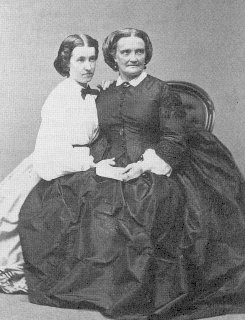
 Emma Conn Crow (April 3, 1839 - September 15, 1920)
Queer Places:
Mount Auburn Cemetery, Cambridge, Middlesex County, Massachusetts, USA
Emma Conn Crow (April 3, 1839 - September 15, 1920)
Born on April 3, 1839, in St. Louis, Missouri, Emma was the youngest daughter of Wayman Crow, a prominent businessman, state senator, and philanthropist, and his wife, Isabella Buck Conn. Her father’s social standing and support for the arts—most notably his patronage of the sculptor Harriet Hosmer—placed Emma in the center of a sophisticated intellectual milieu from a young age.
In her youth, Emma pursued an interest in acting. While living in St. Louis, she entered into a significant romantic relationship with Charlotte Cushman, the internationally acclaimed American stage actress.
Their connection was complex and public within their social sphere. Cushman, who was also romantically linked to the sculptor Harriet Hosmer at the time, navigated these relationships with notable unconventionality. Harriet Hosmer famously wrote to Wayman Crow regarding the bond between Cushman and his daughter, observing that they were "lovers" and expressing admiration for Emma’s "taste."
Emma spent time in Rome living with Cushman and her partner, Emma Stebbins. To stabilize the unconventional love triangle and integrate Emma into her personal family structure, Cushman orchestrated a marriage between Emma and her nephew and adopted son, Edwin Charles "Ned" Cushman. The couple married in St. Louis on April 3, 1861.
Through her association with Cushman, Emma was introduced to an elite circle of reformers, artists, and feminists. She attended Cushman’s renowned salons, where she mingled with influential figures such as: Anna Jameson: Feminist art historian. Fanny Kemble: Celebrated British actress and writer. Adelaide Sartoris: English opera singer and author. Mary Howitt: British author and reformer. Frances Power Cobbe: Irish social reformer and suffragist.
Emma later reflected on Cushman’s charisma, noting her extraordinary ability to "draw out the best from all who came" into her orbit.
In her later years, Emma turned her attention to the study of spiritualism and metaphysical questions. She authored a book titled "Insight; A Record of Psychic Experiences: A Series of Questions and Answers Dealing with the World of Facts, the World of Ideals and the World of Real," which documented her belief in and engagement with psychic phenomena.
Emma Crow Cushman passed away on September 15, 1920, at the age of 81. Her death was attributed to pneumonia.
References:
Other references:
Support this project
This website is a passion project researched, developed, and funded entirely by me. If you find the content valuable and would like to help support the ongoing research and hosting costs, any contribution is deeply appreciated.
Thank you for keeping this independent resource alive!
My books on Amazon: Elisa Rolle's books