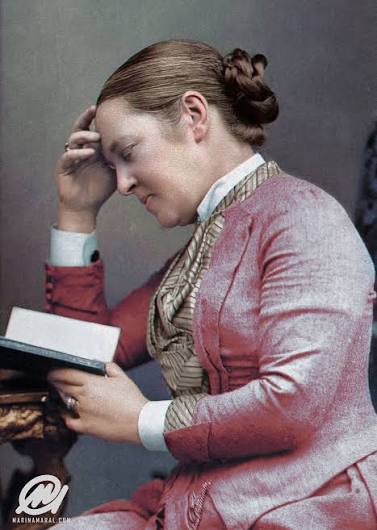
 Elizabeth Garrett Anderson (June 9, 1836 – December 17, 1917) was a pioneering British physician, feminist, and social reformer who broke significant gender barriers in the
19th and early 20th centuries.
Elizabeth Garrett Anderson (June 9, 1836 – December 17, 1917) was a pioneering British physician, feminist, and social reformer who broke significant gender barriers in the
19th and early 20th centuries.Queer Places:
St. Peter and St. Paul Churchyard, Church Rd, Felixstowe IP11 9NF, United Kingdom
Elizabeth Garrett Anderson (June 9, 1836 – December 17, 1917) was a pioneering British physician, feminist, and social reformer who broke significant gender barriers in the
19th and early 20th centuries.
Born on June 9, 1836, in Whitechapel, London, she was the second of eleven children of Newson and Louisa Garrett. Her father was a successful businessman who eventually moved the family to Aldeburgh, Suffolk. Growing up in an atmosphere of "triumphant economic pioneering," Elizabeth was encouraged to take an interest in local affairs and was afforded unusual freedom for a girl of her time.
Facing systemic exclusion from medical schools and professional bodies, Garrett Anderson pursued her ambition with determination:
Unable to enter traditional medical training, she discovered a loophole in the regulations of the Society of Apothecaries, which did not explicitly forbid women from taking its examinations. She studied privately and passed the exams in 1865, becoming the first woman in Britain to formally qualify as a doctor. The Society subsequently changed its rules to prevent other women from following her path.
Still unable to obtain a medical degree in Britain, she taught herself French and earned her degree at the University of Paris.
In 1872, she established the New Hospital for Women (later renamed the Elizabeth Garrett Anderson Hospital). In 1874, she co-founded the London School of Medicine for Women, the first institution in the UK to train women as doctors, where she later served as Dean.
Garrett Anderson was a committed suffragist, campaigning for women's right to vote alongside her sister, Millicent Garrett Fawcett. Her daughter, Louisa Garrett Anderson, also followed in her footsteps as a surgeon and suffragist.
In the latter part of her life, she achieved another historic milestone: She became the mayor of Aldeburgh, making her the first female mayor in Britain.
She passed away in Aldeburgh on December 17, 1917, at the age of 81, just months before women in the UK were granted the right to vote. Her legacy is preserved today through the many hospitals and schools that bear her name, and her work remains a cornerstone of the history of women in medicine.

Photograph taken in the 1890s of Laura Herford’s portrait of Elizabeth
Garrett [Anderson] painted in 1866. Cherry, Deborah. Beyond the Frame
(pp.174-175). Taylor and Francis. Edizione del Kindle.
References:
 Beyond the Frame by Deborah Cherry |
 Women, Peace and Welfare: A Suppressed History of Social Reform, 1880-1920 by Ann Oakley |
Other references:
Support this project
This website is a passion project researched, developed, and funded entirely by me. If you find the content valuable and would like to help support the ongoing research and hosting costs, any contribution is deeply appreciated.
Thank you for keeping this independent resource alive!
My books on Amazon: Elisa Rolle's books