Queer Places:
St Mary the Virgin Churchyard, St Mary in the Marsh, Romney Marsh TN29 0BX, United Kingdom
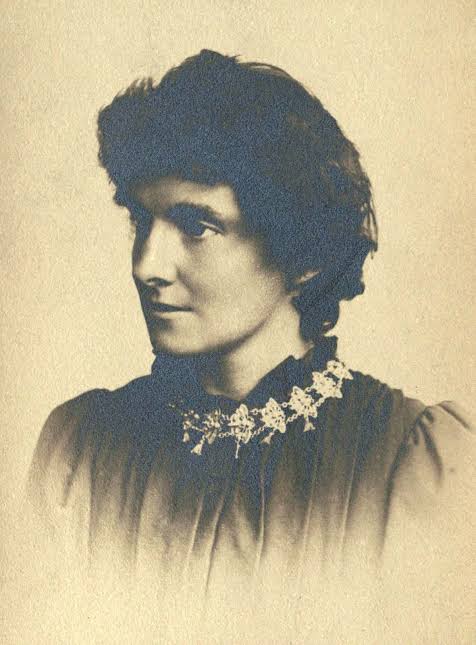 Edith Nesbit (August 15, 1858 – May 4, 1924), widely known by her pen name E. Nesbit, was an English author and poet whose innovative children's literature transformed the
genre, steering it away from traditional moralizing fantasy toward realistic domestic adventures infused with magic.
Edith Nesbit (August 15, 1858 – May 4, 1924), widely known by her pen name E. Nesbit, was an English author and poet whose innovative children's literature transformed the
genre, steering it away from traditional moralizing fantasy toward realistic domestic adventures infused with magic.
Born on August 15, 1858, in Kennington, London, she was the youngest child of agricultural chemist and school founder John Collis Nesbit and Sarah Andrews. Following her
father's death when she was three, her family moved frequently across England, France, and Germany, a nomadic upbringing that fostered her independent spirit and keen
observational skills. In her youth, she developed a deep passion for poetry, publishing her first verses in magazines while still a teenager. Her literary career expanded
rapidly after her marriage to Hubert Bland in 1880, a charismatic yet erratic journalist and socialist with whom she co-founded the Fabian Society. Despite the financial
instability caused by her husband's infidelities, business ventures, and health struggles, Nesbit became the primary breadwinner for an expanding household that included her
own children, children fathered by Bland in extramarital affairs whom Nesbit adopted as her own, and several orphans.
Writing under the initials E. Nesbit to obscure her gender in a male-dominated literary market, she initially achieved modest success with romantic poetry and short
stories. However, her true legacy was forged in middle age when she turned to children's fiction, publishing a string of masterpieces that cemented her reputation. Her
breakthrough came with The Story of the Treasure Seekers in 1899, which introduced the Bastable children and pioneered the genre of the domestic adventure story featuring
imperfect, relatable siblings navigating real-world financial troubles. This was followed by her most celebrated works, including The Wouldbegoods in 1901, Five Children and
It in 1902, The Phoenix and the Carpet in 1904, and her enduring masterpiece The Railway Children in 1906. Nesbit possessed an uncanny ability to capture the authentic voice
and psychology of childhood, blending contemporary domestic realism with fantastical elements like wish-granting sand-fairies and magical carpets. Her characters were active
participants in their own narratives, reflecting the shifting social dynamics and growing individualism of the Edwardian era.
Beyond her literary contributions, Nesbit's personal life was characterized by progressive ideals, unconventional domestic arrangements, and complex emotional
relationships that challenged Victorian norms. While her marriage to Hubert Bland was famously open and tumultuous, Nesbit also formed profound emotional and romantic
attachments with women throughout her life, reflecting the nuanced expressions of same-sex affection and intense female companionship characteristic of late-nineteenth and
early-twentieth-century intellectual circles. Among these significant connections was her relationship with
Mary Josephine Collier, Lady Monkswell, a diarist and prominent figure of the era who recorded the social
and political currents of late-Victorian and Edwardian society. Lady Monkswell’s detailed journals provide valuable historical glimpses into the literary salons, progressive
political circles, and personal networks that Nesbit inhabited. Within these spheres, intense emotional intimacies between women offered a vital source of solidarity,
creative inspiration, and mutual support, operating parallel to or alongside conventional marriages. These relationships highlight the intricate tapestry of Nesbit's
personal world, where traditional domestic structures were constantly renegotiated. Following the death of Hubert Bland in 1914 and the devastating loss of her son Fabian in
World War I, Nesbit's later years were marked by financial hardship and declining health. She eventually settled in Dymchurch, Kent, and later in Jesson, marrying ship's
captain Thomas Terry in 1917. E. Nesbit passed away from lung cancer on May 4, 1924, at the age of sixty-five, leaving behind a monumental literary corpus that heavily
influenced generations of subsequent fantasy authors, including C.S. Lewis, P.L. Travers, and J.K. Rowling, while her life remains a
fascinating study of early feminist agency and boundary-pushing relationships.
References:
- Briggs, Julia. A Woman of Passion: The Life of E. Nesbit, 1858–1924. London: Hutchinson, 1987. (Widely considered the definitive, most comprehensive scholarly biography of Edith Nesbit, drawing extensively on primary papers, letters, and archival material).
- Fitzsimons, Eleanor. The Life and Loves of E. Nesbit: Victorian Iconoclast, Socialist and Creator of The Railway Children. London: Duckworth, 2019. (A modern exploration focusing heavily on her unconventional personal life, relationships, and political activism).
- Galvin, Elisabeth. The Extraordinary Life of E. Nesbit. Barnsley: Pen & Sword Books, 2018.
- Moore, Doris Langley. E. Nesbit: A Biography. London: Ernest Benn, 1933. (The pioneering first-hand biography written with access to people who knew Nesbit personally).
- Streatfeild, Noel. Magic and the Magician: E. Nesbit and her Children’s Books. London: Ernest Benn, 1958.
- Oxford Dictionary of National Biography (ODNB): Nesbit, Edith [married name Edith Bland] — Entry by Julia Briggs.
- Collier, Mary Josephine, Lady Monkswell (1849–1930) — Entry by K. D. Reynolds (documents the life of Lady Monkswell, her social circles, and her prominent diaries recording late-Victorian and Edwardian intellectual life).
- The Monkswell Diaries: A Victorian Diarist: Later Extracts from the Journals of Mary Josephine, Lady Monkswell, 1895–1909 (edited by E. C. F. Collier, London: John Murray, 1946). These journals offer firsthand historical documentation regarding the progressive literary networks, social dynamics, and female intimacies characteristic of the intellectual circles that both Lady Monkswell and Edith Nesbit navigated.
Support this project
This website is a passion project researched, developed, and funded entirely by me. If you find the content valuable and would like to help support the ongoing research and hosting costs, any contribution is deeply appreciated.
Thank you for keeping this independent resource alive!
My books on Amazon: Elisa Rolle's books
BACK TO HOME PAGE