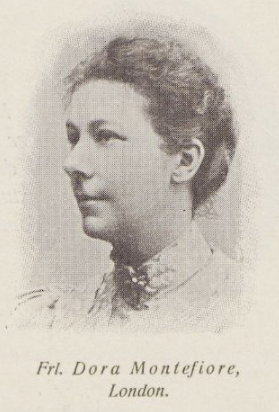
 Dora Montefiore (December 20, 1851 - December 21, 1933) was an English-Australian suffragist, socialist, poet, and pioneer of radical tax resistance.
Queer Places:
Clare Lodge, 32 Upper Mall, London W6 9TA
Dora Montefiore (December 20, 1851 - December 21, 1933) was an English-Australian suffragist, socialist, poet, and pioneer of radical tax resistance.
Her image and name are etched onto the plinth of the statue of Dame Millicent Fawcett in Parliament Square, London. Unveiled in April 2018 and sculpted by Gillian Wearing, the monument features 59 women and men who fought for women's suffrage. Montefiore’s inclusion honors her pivotal role in building the suffrage movement across two continents and her lifelong fight for civil liberties.
Born Dorothy Fuller at Kenley Manor in Surrey into a wealthy family.
In 1874, she traveled to Sydney, where she met and married merchant George Barrow Montefiore in 1881.
When her husband died at sea in 1889, Montefiore discovered that under Victorian law she had no automatic legal rights as the guardian of her two young children unless her husband had explicitly willed them to her.
Enraged by this systemic disenfranchisement, she founded the Womanhood Suffrage League of New South Wales in 1891 at her home in Sydney.
After returning to England in 1892, Montefiore initially worked with Millicent Fawcett's National Union of Women's Suffrage Societies (NUWSS) before joining Emmeline Pankhurst and Sylvia Pankhurst’s militant Women’s Social and Political Union (WSPU) in 1905.
"Women should vote for the laws they obey and the taxes they pay." — Banner hoisted outside Montefiore's home during the 1906 siege.
In 1906, Montefiore orchestrated one of the most famous acts of nonviolent direct action in suffrage history:
Refusing to pay taxes without political representation, she fortified her home in Upper Mall, Hammersmith, against court bailiffs for six weeks.
Later that year, after demonstrating in the lobby of the House of Commons, she was arrested and serving time in Holloway Prison.
Dismayed by the autocratic leadership of the Pankhursts, Montefiore left the WSPU to co-found the Women's Freedom League (WFL) and align with working-class socialist organizations.
In 1913 she organised a scheme to temporarily evacuate the children of striking workers in Dublin to sympathetic families in Britain.
In 1920, at age 69, she helped found the Communist Party of Great Britain (CPGB) and served on its executive committee.
She published her autobiography, From a Victorian to a Modern, in 1927, dying six years later in Hastings.
While Montefiore was married in her early adulthood, her personal life, political ties, and social network intersected directly with early 20th-century queer liberation, same-sex partnerships, and sexual reform:
Montefiore was an active correspondent and collaborator within the circle of Edward Carpenter—the openly gay socialist philosopher and early advocate for homosexual rights ("intermediate sex"). Montefiore engaged heavily in discussing "the sex question," challenging rigid Victorian norms around gender, marriage, and female sexual autonomy alongside socialist thinkers like Jane Clapperton.
Montefiore operated in tight-knit social and political circles comprised of prominent lesbian, bisexual, and same-sex cohabitating suffragists:
Montefiore was close friends with writer and suffragette Cicely Hamilton (co-founder of the Actresses' Franchise League). Hamilton lived in long-term female partnerships and wrote openly about rejecting heterosexual marriage as an economic necessity.
She maintained close friendships with radical figures like Sylvia Pankhurst, who challenged conventional romantic and domestic structures, including Russian revolutionary and sexual theorist Alexandra Kollontai.
The 2018 Parliament Square statue plinth brings together a network of suffragists whose private lives defied the heterosexual norms of their day. Beside Dora Montefiore are several celebrated queer icons of the suffrage movement, including:
Eva Gore-Booth & Esther Roper: Lifelong romantic partners and trade union organizers.
Mary Allen: Suffragette who later co-founded the Women's Police Volunteers and lived openly in same-sex relationships wearing military-style tailored uniforms.
Cicely Hamilton & Edward Carpenter (among the 4 men honored on the plinth).
References:
 Intimate Friends: Women Who Loved Women, 1778-1928 by Martha Vicinus |
Other references:
Support this project
This website is a passion project researched, developed, and funded entirely by me. If you find the content valuable and would like to help support the ongoing research and hosting costs, any contribution is deeply appreciated.
Thank you for keeping this independent resource alive!
My books on Amazon: Elisa Rolle's books