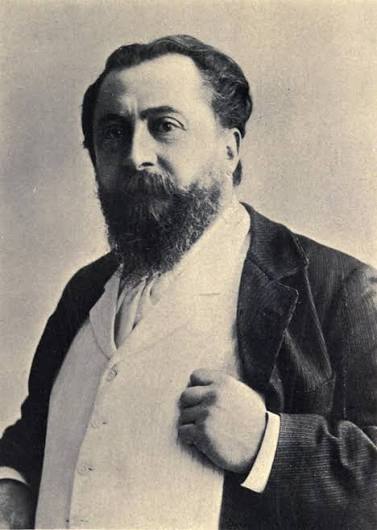
 Catulle Mendès (May 22, 1841 – February 8, 1909) was a prominent French poet, novelist, and man of letters, widely recognized as a key figure in the Parnassian school of
poetry. He was the lover of Marguerite Moreno.
Catulle Mendès (May 22, 1841 – February 8, 1909) was a prominent French poet, novelist, and man of letters, widely recognized as a key figure in the Parnassian school of
poetry. He was the lover of Marguerite Moreno.Wife Judith Gautier, Partner Augusta Holmès, Marguerite Moreno
Queer Places:
Cimetière du Montparnasse, 3 Bd Edgar Quinet, 75014 Paris, France
Catulle Mendès (May 22, 1841 – February 8, 1909) was a prominent French poet, novelist, and man of letters, widely recognized as a key figure in the Parnassian school of
poetry. He was the lover of Marguerite Moreno.
Born Abraham Catulle Mendès in Bordeaux on May 22, 1841, to a Jewish father and a Catholic mother. In 1859, he moved from Toulouse to Paris, where he quickly integrated into the literary scene.
He founded the journal La Revue fantaisiste in 1860. He was a central contributor to the Le Parnasse contemporain collections (1866, 1871, 1876), using his influence to promote Parnassian aesthetics. His body of work was vast and versatile, spanning poetry, novels, short stories, and theatrical libretti. Some of his notable works include the volume of verse Philoméla (1863) and various novels such as Le Roi vierge (1880) and Méphistophéla (1890).
In 1866, he married Judith Gautier, the daughter of his mentor, the poet Théophile Gautier. Following their separation, he began a long-term relationship with the composer Augusta Holmès around 1869, with whom he had five children.
Mendès died in a tragic accident on February 8, 1909, when he fell from a moving train in a railway tunnel near Saint-Germain-en-Laye, believing he had arrived at his station.
Catulle Mendès and the poet/actor Albert Glatigny were friends and associates within the Parnassian movement. Their connection is defined by mutual professional respect and Mendès's role in preserving Glatigny’s legacy:
Mendès helped introduce Glatigny to the Parnasse contemporain circle. He held a deep appreciation for Glatigny’s "bohemian" lifestyle and his talent as a wandering actor and poet, often describing him with great admiration and vivid imagery.
Mendès immortalized Glatigny in his literature:
"Straparole": In his novel La Première Maîtresse (1887), Mendès featured a character named Straparole, who was explicitly modeled after Glatigny. He described him as a "rhymester, ham actor, fallen one star-filled night from Scarron’s comic wagon."
Glatigny (1906): Mendès wrote a play titled Glatigny, drame funambulesque ("Glatigny, a Grotesque Drama"), which was a dramatization of the poet's life and unique personality.
Mendès famously characterized Glatigny as a "sort of d'Artagnan who spars with ballads," highlighting his adventurous and spirited approach to both life and poetry.
References:
Support this project
This website is a passion project researched, developed, and funded entirely by me. If you find the content valuable and would like to help support the ongoing research and hosting costs, any contribution is deeply appreciated.
Thank you for keeping this independent resource alive!
My books on Amazon: Elisa Rolle's books