Queer Places:
Witton Cemetery, Moor Ln, Birmingham B6 7AE, United Kingdom
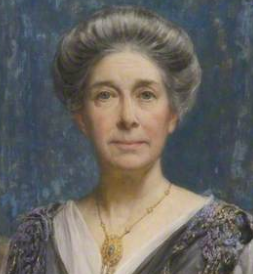 Catherine Courtauld Osler (née Taylor, February 26, 1854 - December 16, 1924) was born on February 26, 1854, in Bridgwater, Somerset, England, into an affluent, politically
progressive Unitarian family. Her parents were William Taylor, an iron merchant, and Caroline Watson Shute. Her family had deep-rooted connections to early social reform and
the nascent women's suffrage movement; notably, her mother was a founding member of the Birmingham Women’s Suffrage Society (BWSS), and her aunt and uncle, Clementia and
Peter Taylor, were prominent Victorian radicals whose London home hosted leading intellectuals like John Stuart Mill and Giuseppe Mazzini.
Catherine Courtauld Osler (née Taylor, February 26, 1854 - December 16, 1924) was born on February 26, 1854, in Bridgwater, Somerset, England, into an affluent, politically
progressive Unitarian family. Her parents were William Taylor, an iron merchant, and Caroline Watson Shute. Her family had deep-rooted connections to early social reform and
the nascent women's suffrage movement; notably, her mother was a founding member of the Birmingham Women’s Suffrage Society (BWSS), and her aunt and uncle, Clementia and
Peter Taylor, were prominent Victorian radicals whose London home hosted leading intellectuals like John Stuart Mill and Giuseppe Mazzini.
In 1873, Catherine married Alfred Clarkson Osler, a wealthy glass manufacturer heading the firm F. & C. Osler. The couple settled in the Edgbaston suburb of Birmingham
and had five children.
Osler quickly established herself as a central figure in Birmingham’s civic, educational, and political landscape:
She founded The Birmingham Ladies' Debating Society (1881) to foster public speaking, intellectual independence, and leadership skills among women.
Following in her mother's footsteps, she became treasurer and later secretary (in 1885) of the Birmingham Women’s Suffrage Society, eventually ascending to the presidency
in 1901.
Osler was a staunch constitutionalist. As a member of the executive committee of the National Union of Women's Suffrage Societies (NUWSS), led by
Millicent Fawcett, she firmly opposed the militant, disruptive tactics deployed by the Women's Social and Political
Union (WSPU) led by the Pankhursts. However, despite her opposition to militancy, she fiercely defended human rights and opposed state brutality; in 1909, she resigned as
president of the Birmingham Women’s Liberal Association in protest against the Liberal government's policy of force-feeding imprisoned suffragettes.
Deeply tied to the Liberal Party early on, she broke with strict party loyalty when necessary, supporting the NUWSS’s Election Fighting Fund from 1912 onward to back
Labour candidates who supported women's enfranchisement.
During the First World War, Osler actively contributed to local civic relief via the Birmingham Citizens Committee. When the Representation of the People Act 1918
partially enfranchised women over 30 who met property qualifications, she viewed it as a vital milestone—though she continually pushed for absolute equality.
In recognition of her decades of civic leadership, the University of Birmingham awarded her an honorary Master’s degree in 1919. She passed away on December 16, 1924, at
her home in Edgbaston, Birmingham.
In 2018, Turner Prize-winning artist Gillian Wearing created the landmark bronze statue of Millicent Fawcett in Parliament Square, London—the first monument of a woman
erected in the square.
The stone plinth of the statue features the names and photographic likenesses of 59 suffrage supporters (57 women and 2 men) who campaigned alongside Fawcett for women's
voting rights. Catherine Courtauld Osler is permanently honored on the plinth alongside other constitutional and militant campaigners, recognizing her foundational decades
of leadership within the British suffrage movement.
References:
- Oxford Dictionary of National Biography: Crawford, Elizabeth. "Osler, Catherine Courtauld (1854–1924)".
- https://spartacus-educational.com/Wosler.htm
- https://www.wikitree.com/wiki/Taylor-113975
- Academic Research: Cotterill, Trevor. "Catherine Osler and the Development of the Political and Social Role of Women in Birmingham 1868 to 1924" (PhD thesis, University of Birmingham).
- https://en.wikipedia.org/wiki/Statue_of_Millicent_Fawcett
- UK Government & Greater London Authority archives on the Centenary Fund unveiling (April 2018).
Support this project
This website is a passion project researched, developed, and funded entirely by me. If you find the content valuable and would like to help support the ongoing research and hosting costs, any contribution is deeply appreciated.
Thank you for keeping this independent resource alive!
My books on Amazon: Elisa Rolle's books
BACK TO HOME PAGE