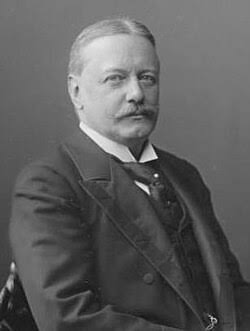
 Bernhard Heinrich Karl Martin von Bülow (May 3, 1849 – October 28, 1929) was a prominent German statesman and diplomat who served as the Chancellor of the German Empire
and Prime Minister of Prussia from 1900 to 1909.
Bernhard Heinrich Karl Martin von Bülow (May 3, 1849 – October 28, 1929) was a prominent German statesman and diplomat who served as the Chancellor of the German Empire
and Prime Minister of Prussia from 1900 to 1909.Queer Places:
Villa Malta delle Rose, Via di Porta Pinciana, 1, 00187 Roma RM, Italy
Friedhof Nienstedten, Elbchaussee, Altona, Hamburg 22609 Germany
Bernhard Heinrich Karl Martin von Bülow (May 3, 1849 – October 28, 1929) was a prominent German statesman and diplomat who served as the Chancellor of the German Empire
and Prime Minister of Prussia from 1900 to 1909.
Born in Klein Flottbek, Holstein, Bülow came from a distinguished Prussian aristocratic family with a history of high-level state service (his father, Bernhard Ernst von Bülow, served as State Secretary for Foreign Affairs under Otto von Bismarck). After serving in the Franco-Prussian War (1870–1871), the younger Bülow entered the German diplomatic corps.
Over the next two decades, he held key diplomatic postings in St. Petersburg, Vienna, Paris, and Bucharest before becoming Minister to Romania in 1888 and Ambassador to Italy in 1893. Highly cultured, charming, and polished, Bülow excelled at courtly politics and cultivated a close personal relationship with Emperor Wilhelm II. In 1897, he was appointed Secretary of State for the Foreign Office.
Bülow was elevated to Imperial Chancellor in 1900. His tenure was defined by an aggressive expansionist foreign policy known as Weltpolitik ("World Policy"), which aimed to secure Germany's status as a global superpower:
He championed Admiral Alfred von Tirpitz’s naval bills, expanding the Imperial German Navy and triggering a naval arms race with Great Britain.
He managed the First Moroccan Crisis (1905–1906), intending to disrupt the Anglo-French Entente Cordiale, though the strategy backfired and isolated Germany diplomatically.
At home, he navigated a delicate coalition of Conservatives and Liberals (the "Bülow Bloc") to pass trade tariffs and tax reforms.
His political standing eroded sharply following the Daily Telegraph Affair of 1908, in which Wilhelm II made disastrous, unvetted foreign policy remarks in a British newspaper interview. Bülow failed to shield the Kaiser adequately from public backlash, damaging their personal relationship. In July 1909, after his budget proposals were defeated in the Reichstag, Bülow resigned.
Following his resignation, Bülow returned to diplomacy during World War I as an extraordinary ambassador to Italy (1914–1915) in an unsuccessful attempt to keep Italy neutral. He spent his final years in Rome writing extensive, highly controversial four-volume memoirs that sought to defend his record and criticize Wilhelm II.
The residence of Imperial Chancellor Bernhard von Bülow in Rome was the Villa Malta, also known as Villa Malta delle Rose, Via di Porta Pinciana, 1, 00187 Roma RM, Italy. Situated on the Pincian Hill (Pincio) in central Rome, located between the Villa Medici and Via di Porta Pinciana near the top of the Spanish Steps. Bülow acquired the historic estate in the early 1900s for his retirement. Following his resignation as Chancellor in 1909, he used Villa Malta as his primary residence and a major social, political, and literary salon. He resided there until his death in Rome on October 28, 1929.
Bernhard von Bülow became a central figure in early 20th-century LGBTQ+ history due to his involvement in the political fallout of the Eulenburg Affair (1907–1909)—one of the largest scandals in Imperial Germany.
In 1907, activist and publisher Adolf Brand—founder of Der Eigene, the world's first homosexual journal—published a pamphlet directly accusing Chancellor von Bülow of same-sex intimacy. Brand alleged that:
Bülow was being blackmailed over his sexuality. Bülow had been seen kissing and embracing his male private secretary, Max Scheefer, at private gatherings hosted by Prince Philipp von Eulenburg.
Brand’s motive was political rather than personal. Unlike Magnus Hirschfeld (who favored medical/scientific advocacy to repeal Paragraph 175, the German law criminalizing male homosexuality), Brand belonged to a radical "masculinist" tradition. He believed that "outing" high-ranking government officials would force the elite to abolish Paragraph 175 to protect themselves from public exposure.
Bülow immediately sued Brand for criminal libel to protect his reputation and cabinet position.
During the trial, Bülow took the stand, explicitly denying under oath that he had ever engaged in homosexual acts or participated in intimate gatherings at Eulenburg's estate.
Prominent sexologist Dr. Magnus Hirschfeld was called to testify. While Hirschfeld had testified about closeted high-ranking officials in related trials, the evidence against Bülow proved unsubstantiated in court.
Brand failed to produce definitive proof for his claims. He was found guilty of libel and sentenced to 18 months in prison.
The trial had a profound impact on the early German homosexual rights movement and public perception of the Imperial government:
As noted in contemporary accounts, even though Bülow won the trial and Brand was jailed, the simple act of dragging the Imperial Chancellor's name into court alongside allegations of illegal sexual conduct left a lasting impression on the public. It created a sense that decadence and hypocrisy were rampant within the Emperor's inner circle.
The outcome highlighted a major divide within the early movement. Hirschfeld and the Scientific-Humanitarian Committee condemned forced "outings," arguing that they generated homophobic moral panics and hurt the cause for legal reform.
The trial, alongside the broader Eulenburg affair, marked one of the first times homosexuality was debated openly across international and German newspapers, moving the subject from medical literature into mainstream political discourse.
References:
 Homintern: How Gay Culture Liberated the Modern World Paperback – November 21, 2017 by Gregory Woods |
Other references:
Support this project
This website is a passion project researched, developed, and funded entirely by me. If you find the content valuable and would like to help support the ongoing research and hosting costs, any contribution is deeply appreciated.
Thank you for keeping this independent resource alive!
My books on Amazon: Elisa Rolle's books